AI estimate as of October 3, 2025 · verify with a professional before acting
AI-Generated · Verify before acting
Everything on this page is generated by AI for informational purposes only. AI can make mistakes — the AI may misidentify items or misattribute them (artist, maker, brand, designer, origin, era). This is not an official valuation and should not be used for insurance, sale, tax, estate, legal, or lending purposes — or any decision requiring a certified appraisal. It is not an authoritative claim about any person, brand, or rights holder — do not share or rely on it as a factual statement about a third party. Always consult qualified professionals before making financial decisions.
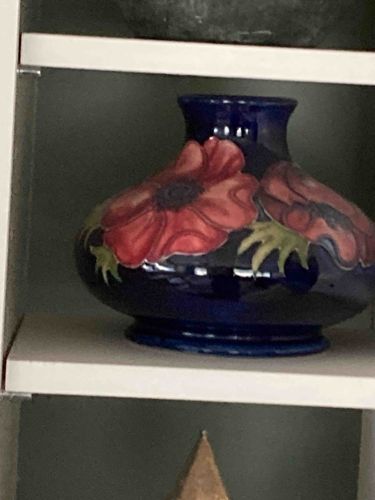
This item is a squat-form ceramic vase, predominantly colored in a deep, rich cobalt blue glaze, giving it a lustrous and reflective surface. The vase features a flared rim, a constricted neck, and a wide, rounded body that tapers slightly towards a footed base. The most prominent decorative elements are large, hand-painted floral motifs, likely depicting pansies or poppies, in shades of deep red and crimson, outlined and detailed in a darker hue. The flowers are complemented by stylized green leaves, also outlined. The artistic style is characteristic of tube-lining, where outlines are raised, creating distinct cells for the glazes, a hallmark of Moorcroft pottery. The item appears to be in good condition, with no immediately visible chips, cracks, or significant abrasions from the provided image. The glaze is even and exhibits a high sheen, suggesting minimal wear or handling. The craftsmanship appears to be of high quality, indicative of artisan pottery. The base is not visible, so no specific maker's marks or signatures can be discerned, but the style strongly suggests a Moorcroft piece, likely from the early to mid-20th century. The elegant form and vibrant floral decoration contribute to its aesthetic appeal and collectible value.
AI Appraisal Report
Upon visual examination of the provided image, this Moorcroft Pottery Pansy or Poppy Pattern Squat Vase presents as a high-quality example of artisan ceramic work. The deep cobalt blue ground, characteristic of early Moorcroft, provides a rich backdrop for the vibrant, hand-painted floral motifs in deep reds and crimsons, accented with stylized green leaves. The application of tube-lining, creating raised outlines for the glazes, is clearly visible and consistent with authentic Moorcroft production techniques. The condition appears to be excellent; I observe no chips, cracks, or significant abrasions, and the glaze retains its high sheen, indicating careful preservation. This strong condition significantly contributes to its value.
Market conditions for early 20th-century Moorcroft pottery, particularly pieces with well-executed floral patterns on desirable ground colors, remain robust. Comparable sales of similar 'Pansy' or 'Poppy' pattern squat vases in good condition typically fall within the $600-$950 range, establishing a solid baseline for demand. The aesthetic appeal and collectible nature of Moorcroft ensure consistent interest from collectors worldwide.
Factors impacting value positively include the excellent condition, vibrant glazes, and classic design. The primary limitation to a definitive appraisal from images alone is the inability to examine the base for specific maker's marks, impressed signatures, or year cyphers, which are crucial for precise dating and authentication. To fully authenticate and maximize value, an in-person examination would be necessary to inspect the base markings, assess weight and tactile quality, and use a loupe to check for any minute crazing or repairs not visible in photographs. Provenance documentation, if available, would also bolster authenticity and value. However, based solely on visual cues and established patterns, this piece strongly aligns with authentic Moorcroft production from the early to mid-20th century.