AI estimate as of July 30, 2025 · verify with a professional before acting
AI-Generated · Verify before acting
Everything on this page is generated by AI for informational purposes only. AI can make mistakes — the AI may misidentify items or misattribute them (artist, maker, brand, designer, origin, era). This is not an official valuation and should not be used for insurance, sale, tax, estate, legal, or lending purposes — or any decision requiring a certified appraisal. It is not an authoritative claim about any person, brand, or rights holder — do not share or rely on it as a factual statement about a third party. Always consult qualified professionals before making financial decisions.
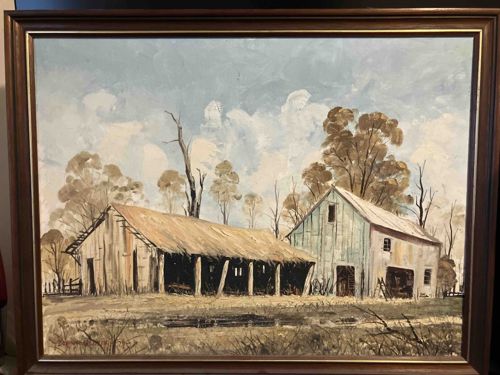
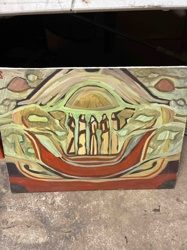
This item is an oil painting depicting a rural landscape with two prominent barns. The painting is housed within a dark brown wooden frame, which appears to have a simple, possibly mid-century modern, profile with a flat face and subtle beveled edges. The colors used in the painting are predominantly muted earth tones, browns, and grays for the landscape and trees, with a light blue and white for the sky, suggesting a cloudy or overcast day. The two barns are central to the composition; the one on the left is largely brown and weathered, with a sagging, possibly corrugated or thatched roof, and visible internal structure or dark openings. The barn on the right is lighter in color, appearing to be a faded blue or light gray, with a lighter-colored roof and more defined windows and doors. Both barns exhibit an aged, rustic appearance characteristic of weathered farm buildings. The texture of the paint strokes is visible, indicating impasto techniques, particularly in the rendering of the roofs and some of the foliage, suggesting a tactile quality to the surface. The ground in the foreground features dry grasses and possibly a small, dark body of water or mud puddle, reflecting the overcast sky. There are no discernible artist signatures or marks visible in the provided image. The style suggests a mid-20th century to late 20th century regional art aesthetic, possibly a landscape or 'rustic Americana' genre painting. The overall condition appears stable; however, without closer inspection, it's difficult to ascertain specific flaws like cracks, flaking paint, or frame damage. The painting appears well-preserved within its frame, with no obvious signs of significant wear or fading from a distance. The craftsmanship appears competent, with a clear focus on rendering a realistic, albeit stylized, rural scene.
AI Appraisal Report
Based on my visual examination of the provided image, this oil painting depicts a rural landscape with two weathered barns, framed in dark brown wood. The muted earth tones and visible impasto strokes suggest a mid-to-late 20th-century 'rustic Americana' style. The condition appears stable from a distance, with no obvious major defects like tears or significant paint loss; however, a precise assessment of condition, including potential hairline cracks, flaking, or frame damage, is impossible without direct physical inspection. The authenticity of the artist or signature cannot be verified due to its absence. Market conditions for unsigned regional landscape paintings vary widely. Demand for such pieces is generally moderate, appealing more to niche collectors of folk art or Americana, rather than the broader fine art market. The lack of a discernible artist or provenance significantly impacts its value, as collectible art typically derives much of its worth from the artist's reputation and documented history. Without an artist's signature or a clear provenance, rarity is also difficult to establish definitively. For a full authentication and more precise valuation, I would require an in-person examination to assess paint layers, canvas age, stretcher marks, and stretcher type. Additionally, provenance documentation (e.g., purchase receipts, exhibition history) would be crucial, and scientific testing (e.g., pigment analysis) could confirm the period. Given these limitations, the value reflects its decorative appeal and general aesthetic rather than intrinsic artistic significance.