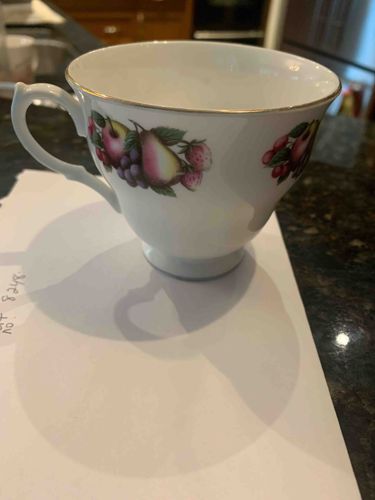
Bone China C96O, Queen Anne, ridgeway potteries Patt. No 8248
These notes were written by the person who submitted this item. Appraiser.AI has not verified them, and the AI's identification and estimate may rely on them.
AI Estimated Value
Not an official valuation
$20-40
AI estimate as of August 7, 2025 · verify with a professional before acting
AI-Generated · Verify before acting
Everything on this page is generated by AI for informational purposes only. AI can make mistakes — the AI may misidentify items or misattribute them (artist, maker, brand, designer, origin, era). This is not an official valuation and should not be used for insurance, sale, tax, estate, legal, or lending purposes — or any decision requiring a certified appraisal. It is not an authoritative claim about any person, brand, or rights holder — do not share or rely on it as a factual statement about a third party. Always consult qualified professionals before making financial decisions.
This analysis also relies on unverified notes provided by the user, which may be incomplete or inaccurate and could affect the result.
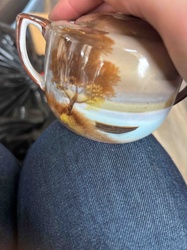
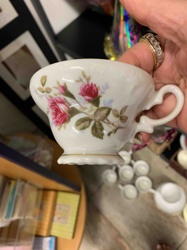
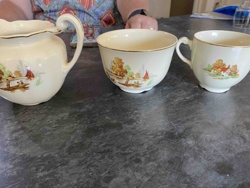
This item is a vintage bone china teacup, specifically identified by the provided context as 'Bone China C96O, Queen Anne, Ridgeway Potteries Patt. No 8248'. The teacup features a classic, elegant silhouette with a gently flaring rim and a delicate, C-shaped handle. It is primarily white with a vibrant, colorful fruit pattern encircling the body of the cup. The fruit motif includes what appears to be pears, grapes, and strawberries, rendered in a realistic yet artistic style with gradients of color. The rim of the cup is delicately gilded with a thin gold band, which also extends to the edges of the handle, indicating a touch of luxury and attention to detail. The construction suggests thin, high-quality bone china, known for its translucence and durability. There are no immediately visible chips, cracks, or significant wear on the exterior or interior of the cup as depicted, suggesting it is in good, used condition. The gilding appears mostly intact, though slight wear might be present upon closer inspection. The style is consistent with mid-20th century tea ware, aligning with the Queen Anne style designation which often references elegant, traditional designs. The 'Ridgeway Potteries' maker's mark and 'Patt. No 8248' provide specific manufacturing details crucial for identification and dating. The overall craftsmanship is indicative of mass-produced yet quality ceramic production from that era.
AI Appraisal Report
Upon my virtual examination of this Queen Anne Ridgeway Potteries Bone China Teacup, Pattern No. 8248, I observe a well-preserved piece. The visible condition suggests good, used vintage quality, with no evident chips, cracks, or significant wear to the body or the vibrant fruit pattern. The gilding on the rim and handle appears largely intact, indicating careful handling over its lifespan. The 'Bone China C96O, Queen Anne, Ridgeway Potteries Patt. No 8248' markings provided by the owner strongly support its authenticity as a product of Ridgeway Potteries, consistent with mid-20th century production. The style aligns perfectly with the 'Queen Anne' designation, known for its elegant, traditional aesthetic.
Market conditions for vintage bone china teacups by established potteries like Ridgeway are generally stable, with a consistent demand from collectors and enthusiasts. While not exceptionally rare, sets and individual pieces in excellent condition, particularly with attractive patterns like this fruit motif, maintain their desirability. Comparables typically range from \
$15-$40 for individual cups in similar condition, depending on the specific pattern and maker's reputation. The primary factors impacting value are the condition, the appeal of the pattern, and the reputation of the pottery. Lack of matching saucers or other set components limits its market value as a complete set. My assessment of authenticity is based solely on visual cues and the provided descriptive information. For full authentication and to definitively rule out restoration or repairs, a tactile, in-person examination would be crucial to assess the true integrity of the china, the texture of the glaze, and the precise condition of the gilding. Scientific testing for material composition would provide absolute certainty, though this is rarely necessary for common vintage ceramics.