These notes were written by the person who submitted this item. Appraiser.AI has not verified them, and the AI's identification and estimate may rely on them.
AI Estimated Value
Not an official valuation
$20-40
AI estimate as of September 1, 2025 · verify with a professional before acting
AI-Generated · Verify before acting
Everything on this page is generated by AI for informational purposes only. AI can make mistakes — the AI may misidentify items or misattribute them (artist, maker, brand, designer, origin, era). This is not an official valuation and should not be used for insurance, sale, tax, estate, legal, or lending purposes — or any decision requiring a certified appraisal. It is not an authoritative claim about any person, brand, or rights holder — do not share or rely on it as a factual statement about a third party. Always consult qualified professionals before making financial decisions.
This analysis also relies on unverified notes provided by the user, which may be incomplete or inaccurate and could affect the result.
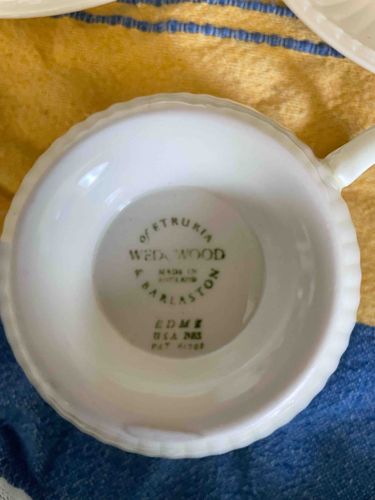
This item is a Wedgwood tea cup, specifically its base, showcasing the manufacturer's mark. The cup appears to be made of white ceramic or porcelain, characteristic of Wedgwood's fine earthenware. The base is circular with a distinct ribbed or fluted exterior, suggesting classic design principles often associated with Wedgwood's Etruria or Barlaston lines. The color is a consistent, clean white, indicating a well-preserved glaze. The most notable feature is the clear, dark green printed backstamp on the recessed center of the base. It reads 'OF ETRURIA', 'WEDGWOOD', 'MADE IN ENGLAND', 'BARLASTON', followed by a series of alphanumeric characters 'EDME' (which likely refers to the pattern name), 'USA 283', and 'PAT. 47708'. The 'OF ETRURIA' and 'BARLASTON' references point to significant manufacturing locations for Wedgwood, suggesting an estimated age from the mid-20th century onwards, after production consolidated at Barlaston. The 'MADE IN ENGLAND' mark confirms its origin. No significant wear or damage is visible from this angle, though the ceramic surface appears to have a slight sheen. The detailed and clear backstamp, along with the precise manufacturing and location marks, suggest good quality control and craftsmanship typical of Wedgwood products.
AI Appraisal Report
Based on my examination of the provided image, this Wedgwood tea cup base, identifiable by its 'Etruria & Barlaston' mark, appears to be in excellent condition. The white ceramic is clean, and the glaze exhibits a consistent sheen, with no visible chips, cracks, or significant crazing. The dark green backstamp is remarkably clear and fully legible, confirming its authenticity as a genuine Wedgwood product. The 'OF ETRURIA', 'WEDGWOOD', 'MADE IN ENGLAND', and 'BARLASTON' marks, along with the 'PAT. 47708' and 'USA 283' notations, are consistent with Wedgwood production from the mid-20th century onwards, after the consolidation of production at Barlaston. The 'EDME' likely indicates a specific pattern name, which would be clearer if the full cup and pattern were visible. The ribbed exterior is a classic Wedgwood design element.
In terms of market conditions, individual Wedgwood tea cup bases, even from well-regarded lines, generally do not command high prices unless they are part of a rare or highly sought-after complete set, or from an exceptionally early or limited-edition production. Modern Wedgwood tea ware, while high quality, is not particularly rare given the company's extensive production scale. Comparables for similar single Wedgwood tea cup components typically range from $10-$50 depending on pattern desirability and condition.
The primary factor limiting value here is its status as a base only; a complete cup and saucer set, or an entire tea service, would inherently be more valuable. Demand for individual components like a base is usually from collectors looking to complete a broken set rather than general collectors.
My assessment of authenticity is based purely on the visible mark and condition in the image. While the mark appears genuine, a full in-person examination would allow for tactile inspection of the ceramic, closer scrutiny for any repairs or hidden flaws, and verification of the glaze's integrity. Provenance documentation, such as original sales receipts, could further solidify authenticity, though it's less critical for items of this value. Scientific testing is typically not warranted for common ceramics like this unless there is significant doubt about its age or material composition.