AI estimate as of August 24, 2025 · verify with a professional before acting
AI-Generated · Verify before acting
Everything on this page is generated by AI for informational purposes only. AI can make mistakes — the AI may misidentify items or misattribute them (artist, maker, brand, designer, origin, era). This is not an official valuation and should not be used for insurance, sale, tax, estate, legal, or lending purposes — or any decision requiring a certified appraisal. It is not an authoritative claim about any person, brand, or rights holder — do not share or rely on it as a factual statement about a third party. Always consult qualified professionals before making financial decisions.
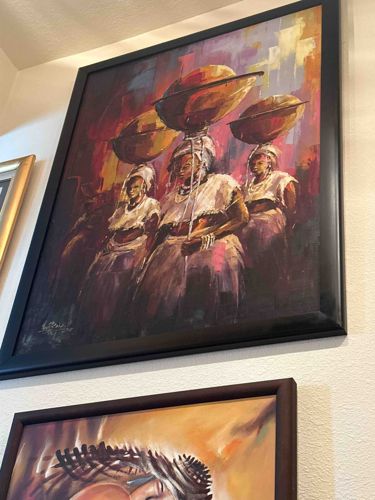
The item is a framed piece of artwork, likely a painting or a high-quality print, depicting three African women carrying large, bowl-shaped objects on their heads. The art style appears to be expressionistic or abstract, characterized by bold brushstrokes and a vibrant color palette dominated by deep reds, purples, oranges, and yellows, creating a warm and energetic background. The women's figures are rendered with visible texture and less defined features, emphasizing their form and the act of carrying. They are dressed in light-colored, possibly white or cream-colored, garments with a loose fit, suggesting traditional attire. Notable features include the detailed rendering of the baskets or bowls on their heads, which have a metallic or earthenware appearance due to the interplay of light and shadow, and what appear to be subtle adornments or jewelry around the necks of the central figures. The overall condition of the visible surface of the artwork appears to be very good with no obvious signs of damage, fading, or wear, though close inspection would be needed to confirm this. The artwork is housed in a substantial, dark-colored, possibly black, wooden or composite frame with a smooth finish, suggesting a modern or contemporary framing style. No visible artist's signature or specific manufacturing details are clearly discernible from the provided image, although a faint signature might be present in the lower left corner. The estimated age is contemporary, likely from the late 20th to early 21st century, given the style and framing. The quality indicators include the apparent professional framing and the evocative use of color and composition, suggesting a piece of artistic intent and skill.
AI Appraisal Report
Upon visual examination of the provided image, this framed artwork, depicting three African women carrying baskets, appears to be in very good condition with no apparent damage, fading, or wear to the visible surface. The framing is robust and contemporary, suggesting professional presentation. Authenticity, based solely on this image, is limited; while a faint signature might be present in the lower left, it is not clearly discernible. This piece is likely a painting or a high-quality print from the late 20th to early 21st century, given its style and framing.
In terms of market conditions, art depicting African themes, particularly figures engaged in traditional activities, has a consistent if niche demand. The vibrant, expressionistic style and warm color palette are appealing and could attract buyers seeking decorative art with cultural depth. Comparables would include contemporary art pieces by emerging or mid-career artists focusing on similar cultural motifs, or high-quality decorative prints. Demand for this specific piece would likely be from private collectors, interior designers, or individuals decorating homes with a global or ethnic aesthetic. Rarity cannot be determined without knowing if this is an original or part of an edition.
Factors significantly impacting value include the potential originality (painting vs. print), the artist's identity and provenance. If it were a verified original painting by a recognized artist, the value would increase substantially. Conversely, if it's a mass-produced print, the value would be considerably lower.
Limitations in authenticity verification from the image alone are significant. A full authentication would require an in-person examination to differentiate between paint texture (original vs. print), assess the medium, and precisely identify any signature. Provenance documentation (bill of sale, exhibition history) would be crucial to establish its history and origin. Scientific testing, such as pigment analysis, could confirm age and medium, further aiding authenticity if deemed necessary.