AI estimate as of July 8, 2025 · verify with a professional before acting
AI-Generated · Verify before acting
Everything on this page is generated by AI for informational purposes only. AI can make mistakes — the AI may misidentify items or misattribute them (artist, maker, brand, designer, origin, era). This is not an official valuation and should not be used for insurance, sale, tax, estate, legal, or lending purposes — or any decision requiring a certified appraisal. It is not an authoritative claim about any person, brand, or rights holder — do not share or rely on it as a factual statement about a third party. Always consult qualified professionals before making financial decisions.
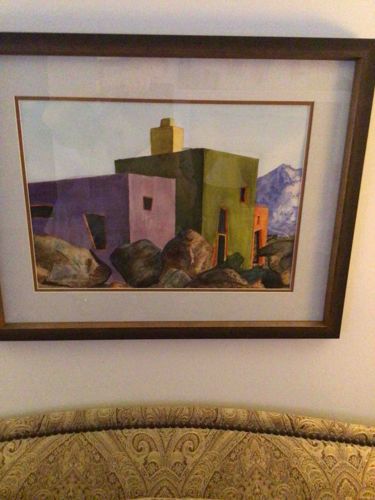
The item is a framed piece of artwork depicting an architectural landscape or cityscape, likely a New Mexico Adobe style scene. The primary subject matter consists of several cubist or semi-abstract buildings rendered in a palette of muted and earthy tones, specifically shades of purple, dark green, and orange. One building features a distinctive yellow chimney-like structure. In the foreground, large, naturalistic rock formations are visible, grounding the more abstract built environment. The background reveals a stylized depiction of mountain ranges, possibly indicating a desert or arid environment. The artwork appears to be a print or a watercolor behind glass, as evidenced by the slight reflections, and is enclosed in a simple, dark brown wooden frame with a visible grain. A white or off-white mat board separates the artwork from the frame, providing visual breathing room. The style suggests a mid-to-late 20th-century aesthetic, possibly influenced by Southwestern art movements. There are no obvious signs of significant damage or wear on the visible surface of the artwork or frame, though minor dust or smudges on the glass are possible given it's a household item. The craftsmanship appears to be standard for framed art, with a clean mat cut and well-fitted frame. No artist's signature or specific markings are discernible from the provided image.
AI Appraisal Report
I have carefully examined the image of this framed Southwestern architectural landscape. Based on my visual assessment, the artwork appears to be in good overall condition. There are no obvious signs of significant damage to the visible artwork, such as tears, fading, or major discoloration. The frame is a simple dark wood, and the mat board appears clean and well-cut. The presence of reflections suggests it is behind glass, protecting the medium. Authenticity is challenging to definitively verify from an image alone. While the style strongly evokes Southwestern art from the mid-to-late 20th century, confirming if it's an original print (e.g., lithograph, serigraph), a reproduction, or even a unique work like a watercolor cannot be definitively determined without physical inspection. The lack of a visible signature further complicates attribution.
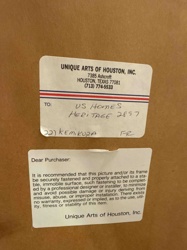
From a market perspective, works of this aesthetic, particularly those depicting New Mexico Adobe or similar cubist architectural landscapes, generally appeal to regional collectors and those interested in Southwestern decor. However, without artist attribution or a known edition, it falls into a broader decorative art category. Comparables would include mass-produced art prints or watercolors from unlisted artists. Demand is moderate, but rarity is low given it's likely a print or reproduction. Factors significantly impacting value include the lack of an identifiable artist, the specific print medium (e.g., original lithograph vs. a giclée print), and ultimately, whether it's an original work or a reproduction. An in-person examination would be crucial to determine the exact medium, assess the quality of the print or artwork, check for an embedded signature or edition number (often hidden by the mat), and inspect the verso for any artist labels or provenance. Scientific testing, like pigment analysis, would be needed for absolute authentication if an artist is later identified. Without such verification, it functions primarily as a decorative piece.