AI Appraisal Estimate

AI-generated estimates · not official valuations

From the user

What was submitted

Photo and notes provided by the user — not generated by AI

Submitted item photo
Submitted photo · June 13, 2026

User's notes

No additional notes provided.

AI analysis below

AI appraisal

AI analysis & estimate

AI-Generated · Verify before acting

Everything below is generated by AI for informational purposes only. AI can make mistakes — the AI may misidentify items or misattribute them (artist, maker, brand, designer, origin, era). This is not an official valuation and should not be used for insurance, sale, tax, estate, legal, or lending purposes — or any decision requiring a certified appraisal. It is not an authoritative claim about any person, brand, or rights holder — do not share or rely on it as a factual statement about a third party. Always consult qualified professionals before making financial decisions.

Read the full disclaimer

AI Identification

·Not independently authenticated·Verify before acting

Traditional Chinese Ink and Wash Painting Print of Bamboo and Flowers

Asian Art / Prints and Works on Paper

AI Estimated Value

·Not an official valuation·Verify before acting

$150 - $300

As of June 13, 2026

AI Item Analysis

·AI can make mistakes·Verify before acting
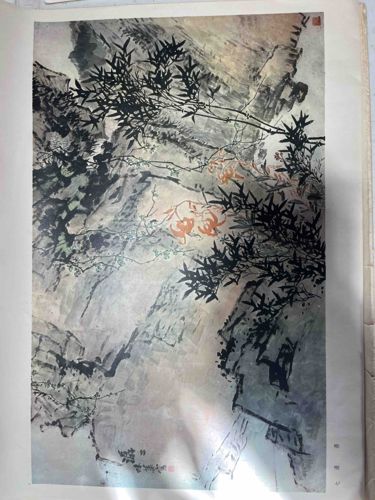
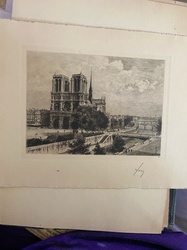
This item is a large-format print of a traditional Chinese ink and wash (Shuimo) painting, presented in a portrait orientation within a book or portfolio. The artwork features a complex composition of vertical rock formations rendered in varying shades of gray and blue-toned washes. In the foreground and middle ground, thickets of dark black ink bamboo leaves contrast sharply with delicate orange lilies or similar floral elements. The brushwork reflects a 'xieyi' (freehand) style, characterized by spontaneous, expressive strokes and wet-ink techniques. Two distinct red seal stamps (cuan) are visible: one in the upper right corner and another in the lower center, which typically denote the artist's signature or studio. The paper shows a natural cream-colored patina consistent with vintage printed paper. There are visible condition issues including slight curling at the edges, minor foxing on the surrounding margins, and a vertical crease or shadow cast across the lower half of the page from the lighting or binding. The printing quality appears high, capturing the subtle bleed and texture of the original ink on rice paper. It likely dates from the mid-to-late 20th century as part of a high-quality art retrospective or publication.
AI Appraisal Report

·AI can make mistakes·Verify before acting
I have examined the provided image of the large-format print depicting bamboo, rockery, and lilies in the 'xieyi' style. The work displays characteristic mid-to-late 20th-century color lithography or high-quality offset printing techniques intended to replicate the appearance of traditional 'Sheng Xuan' (raw rice paper). The application of ink-wash gradients and the saturation of the cinnabar-colored seals suggest this was produced for a high-end art anthology or commemorative portfolio. Condition: The piece shows visible age-related wear, including foxing in the margins and a prominent vertical shadow/crease likely resulting from the binding of the original volume. These 'mechanical' defects, coupled with the curling edges, slightly detract from the display value. Market Analysis: In the current market for Asian art reprints, value is driven by the fame of the original artist (likely a modern master such as Wu Changshuo or Qi Baishi) and the quality of the facsimile. While visually striking, as a printed reproduction rather than an original hand-painted work, it is categorized as decorative or reference material. High-quality mid-century prints of this nature maintain a steady but modest niche among collectors of Sinology and interior designers. Limitations: This appraisal is based solely on digital imagery. Definitive authentication requires physical inspection to evaluate paper fiber composition, ink penetration, and the absence of halftone dots under magnification. To confirm if this is a limited edition woodblock print (which would increase value) versus a standard lithograph, I would need to examine the 'bite' of the ink into the substrate and review any associated provenance or publication records from the original folio.

Get your items appraised

Instant estimates of your treasures with AI-powered appraisals

Browse More Appraisals