AI estimate as of September 14, 2025 · verify with a professional before acting
AI-Generated · Verify before acting
Everything on this page is generated by AI for informational purposes only. AI can make mistakes — the AI may misidentify items or misattribute them (artist, maker, brand, designer, origin, era). This is not an official valuation and should not be used for insurance, sale, tax, estate, legal, or lending purposes — or any decision requiring a certified appraisal. It is not an authoritative claim about any person, brand, or rights holder — do not share or rely on it as a factual statement about a third party. Always consult qualified professionals before making financial decisions.
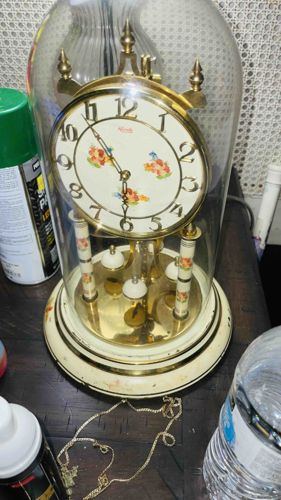
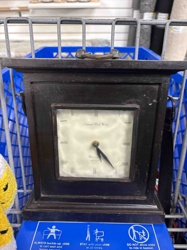
This item is a Kundo 400-Day Anniversary Clock, also known as a 'torsion pendulum clock,' encased within a clear glass dome. The clock features a white circular face with black Arabic numerals for hours 1 through 12. The center of the clock face is adorned with a delicate floral motif, displaying clusters of small orange, pink, and blue flowers with green leaves, adding a decorative touch. 'Kundo' is visibly printed in red script near the '12' position, indicating the manufacturer. The hands appear to be a dark metallic color, likely black or dark brown, with a simple, elegant design. The clock mechanism is supported by a brass-toned frame, featuring four decorative finials at the top corners that extend upwards from the main clock body. Beneath the clock face, the torsion pendulum mechanism is visible, consisting of a brass-toned circular platform from which four decorative support columns rise. These columns appear to be adorned with floral patterns matching the clock face. The pendulum itself is a series of four brass-toned balls suspended by a thin wire, designed to oscillate slowly, often for a year (400 days) on a single winding. The entire clock mechanism rests on a round, stepped base, which appears to be made of a painted material, possibly metal or wood, with an aged off-white or cream color. The base shows visible wear and discoloration, particularly around the edges and on the flat surface, suggesting age and use. There are brown and orange-ish stains or dirt marks on the base. The transparent glass dome covers the clock and its mechanism, protecting it from dust and environmental factors. The dome itself appears clear with some reflections, indicating it is made of glass. The overall style suggests a mid-20th-century aesthetic, common for these types of anniversary clocks. The craftsmanship appears to be of moderate quality, with decorative elements adding to its appeal. The visible wear on the base indicates this is a used item.
AI Appraisal Report
I have examined the provided image of a Kundo 400-Day Anniversary Clock with a glass dome. Authenticity appears to be strong based on the 'Kundo' branding visible on the dial, which is consistent with known examples of their anniversary clocks. The decorative floral motif on the dial and mechanism supports a mid-20th-century aesthetic, typical for these pieces. The clock's condition, however, shows significant wear, particularly on the painted base which exhibits noticeable discoloration, stains, and dirt marks. While the glass dome appears intact, general cleanliness and internal condition of the mechanical components cannot be fully assessed from the image alone. The brass components show some patina, but no immediate signs of severe damage or missing parts are visible.
Market conditions for Kundo 400-day clocks are generally moderate. These clocks were mass-produced, so rarity is not a significant factor. Demand is steady but not exceptionally high, primarily from collectors or individuals seeking decorative nostalgic items. Comparable sales for Kundo 400-day clocks in similar, used condition typically range from $60 to $150, with pristine, fully serviced examples fetching slightly higher prices. The visible wear on the base is the primary factor impacting the value negatively, as it detracts from the aesthetic appeal and suggests a lack of careful maintenance. A professional cleaning and potential restoration of the base, along with a service of the movement, would likely increase its value.
Limitations in authenticity verification from the image alone include the inability to inspect the clock's movement for specific Kundo markings or serial numbers, which would confirm its origin and potential production date. An in-person examination would allow for a thorough inspection of the movement's condition, functionality, and originality of all components. Furthermore, checking for any repairs or replacement parts not original to the clock would require physical handling. Provenance documentation, such as original sales receipts or service records, would further enhance authentication and value.