AI Appraisal Estimate

AI-generated estimates · not official valuations

From the user

What was submitted

Photo and notes provided by the user — not generated by AI

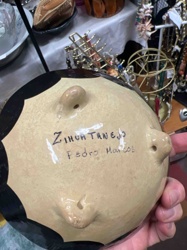
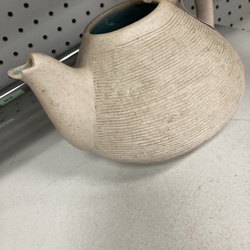
Submitted item photo
Submitted photo · June 20, 2026

User's notes

No additional notes provided.

AI analysis below

AI appraisal

AI analysis & estimate

AI-Generated · Verify before acting

Everything below is generated by AI for informational purposes only. AI can make mistakes — the AI may misidentify items or misattribute them (artist, maker, brand, designer, origin, era). This is not an official valuation and should not be used for insurance, sale, tax, estate, legal, or lending purposes — or any decision requiring a certified appraisal. It is not an authoritative claim about any person, brand, or rights holder — do not share or rely on it as a factual statement about a third party. Always consult qualified professionals before making financial decisions.

Read the full disclaimer

AI Identification

·Not independently authenticated·Verify before acting

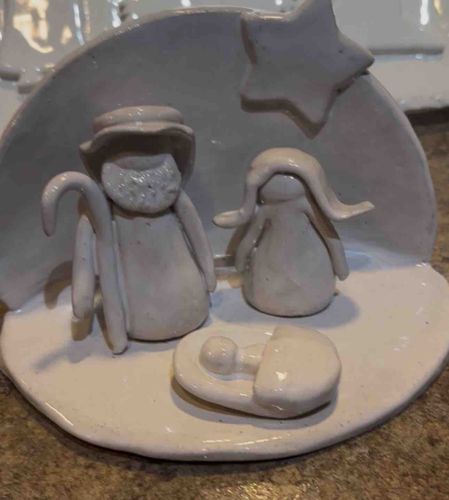
Hand-Sculpted White Ceramic Nativity Scene

Religious Folk Art / Studio Pottery

AI Estimated Value

·Not an official valuation·Verify before acting

$45.00 - $85.00

As of June 20, 2026

AI Item Analysis

·AI can make mistakes·Verify before acting
This is a hand-formed ceramic nativity set featuring a minimalist, folk-art style. The piece is constructed from what appears to be a light-colored earthenware or stoneware clay, coated in a thick, monochromatic white semi-gloss glaze. The assembly consists of four primary elements: a figure representing Joseph holding a shepherd's crook, a figure representing Mary, a small infant figure in a manger, and a curved backplate with an embossed five-pointed star. The figures are faceless, utilizing simple shapes and clay folds to suggest identity and emotion, a hallmark of contemporary primitive religious art. The Joseph figure includes textured clay to represent a beard and a wide-brimmed hat, while Mary is depicted with draped clay suggesting a headscarf. The background plate is a semi-circular slab, roughly finished at the edges, which serves as a stable base for the scene. There are visible fingerprints and tool marks throughout the glaze, indicating a handmade, studio-crafted origin rather than mass production. The condition appears sound with no visible structural cracks, though the glaze shows slight unevenness and pool marks characteristic of kiln-fired hobbyist or local artisan work. The style suggests a late 20th-century to early 21st-century origin, likely made in a community pottery studio or as a one-of-a-kind art piece.
AI Appraisal Report

·AI can make mistakes·Verify before acting
Based on my visual examination of this four-piece hand-sculpted ceramic nativity, I have assessed it as contemporary religious folk art, likely of mid-to-late 20th-century origin. The set exemplifies a 'minimalist-primitive' aesthetic, characterized by faceless figures and tactile tool marks. The monochromatic white glaze shows characteristic pooling and unevenness, which, along with the visible fingerprints, confirms its origin as studio pottery rather than mass-produced slip-cast ware. The condition appears excellent with no visible crazing, chips, or repairs, though the rough-hewn edges of the star backplate are stylistic rather than indicative of damage. The market for anonymous studio pottery remains stable but modest. Comparables for unsigned, local artisan nativity sets typically sell within the $40 to $100 range at regional craft galleries or specialized auctions. The value is driven by the 'handmade' appeal and seasonal demand rather than the reputation of a specific artist, as no maker’s mark was identified. Limitations: My assessment is based solely on high-resolution imagery. Without a physical inspection, I cannot verify the exact clay body composition or check for internal stress fractures hidden beneath the thick glaze. To provide a definitive valuation, I would require an in-person examination of the base for any faint impressed signatures or studio stamps. Provenance documenting the specific artist or the pottery school of origin would also be necessary to move this piece into a higher 'collectible' tier. A physical 'ring test' to check the resonance of the fired clay would further confirm the structural integrity of the ceramic.

Get your items appraised

Instant estimates of your treasures with AI-powered appraisals

Browse More Appraisals