AI Appraisal Estimate

AI-generated estimates · not official valuations

From the user

What was submitted

Photo and notes provided by the user — not generated by AI

Submitted item photo
Submitted photo · June 25, 2026

User's notes

No additional notes provided.

AI analysis below

AI appraisal

AI analysis & estimate

AI-Generated · Verify before acting

Everything below is generated by AI for informational purposes only. AI can make mistakes — the AI may misidentify items or misattribute them (artist, maker, brand, designer, origin, era). This is not an official valuation and should not be used for insurance, sale, tax, estate, legal, or lending purposes — or any decision requiring a certified appraisal. It is not an authoritative claim about any person, brand, or rights holder — do not share or rely on it as a factual statement about a third party. Always consult qualified professionals before making financial decisions.

Read the full disclaimer

AI Identification

·Not independently authenticated·Verify before acting

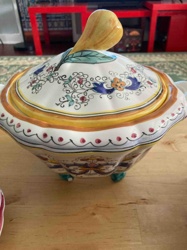
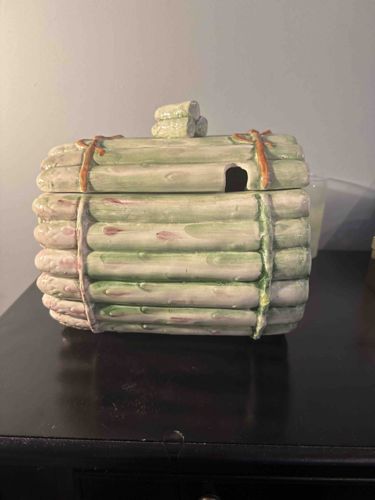
Trompe-l'œil Faience Asparagus Bundle Tureen

Antique/Vintage Ceramic Tableware

AI Estimated Value

·Not an official valuation·Verify before acting

$450 - $650

As of June 25, 2026

AI Item Analysis

·AI can make mistakes·Verify before acting
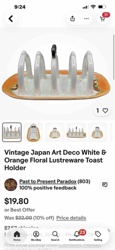
This item is a hand-painted ceramic tureen or covered server, expertly crafted in the 'trompe-l'œil' (deceive the eye) style to resemble a bundled bunch of fresh asparagus stalks. The piece consists of a deep rectangular base and a matching fitted lid, both constructed to simulate horizontal spears held together by vertical bindings. The coloration features a naturalistic palette of pale creamy whites, soft sage greens, and delicate purple-tipped buds. Darker green accents highlight the textured 'scales' of the spears, while the faux-twine bindings are rendered in a contrasting ochre-orange. A unique design element is the handle on the lid, which is shaped like three small, severed asparagus segments bundled together. The lid also features a functional cutout notch, designed to accommodate a serving ladle. The craftsmanship shows high-quality glaze application with subtle tonal transitions, indicating a piece likely influenced by 18th-century French Longchamp or Portuguese Bordallo Pinheiro traditions, though it is likely a mid-20th-century revival piece. The condition appears fair to good; there are visible manufacturing seams and some minor wear to the glaze along the edges where the lid meets the base. No prominent maker's marks are visible from this angle, but the irregular texture and hand-applied pigments suggest a slip-cast ceramic process with significant hand-finishing.
AI Appraisal Report

·AI can make mistakes·Verify before acting
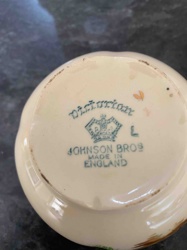
I have virtually examined this trompe-l'œil faience asparagus bundle tureen. The piece exhibits characteristic mid-20th-century revivalist traits, likely originating from a European workshop such as Portuguese Bordallo Pinheiro or a French atelier influenced by 18th-century Sceaux or Longchamp designs. The naturalistic palette and hand-painted details on the bud scales and ochre 'twine' bindings are well-executed. Condition appears fair to good; however, visible wear and minor glaze chips along the lid-to-base flange suggest historical use, which slightly impacts the premium value typically reserved for mint specimens. The market for botanical trompe-l'œil ceramics remains steady among specialized collectors and high-end interior designers. Comparables for mid-sized tureens of this quality currently range between $400 and $700 at auction and decorative arts galleries. The inclusion of the ladle notch adds functionality and appeal, though the absence of a matching ceramic ladle reduces the set's overall collectibility. Limitations to this appraisal must be noted. As this is a visual inspection of an image, I cannot verify the presence or authenticity of base markings which could significantly alter the valuation—for instance, an authentic 18th-century attribution would move the value into the thousands. Further in-person examination is required to check for internal hairline fractures not visible in the provided view and to assess the weight and resonance of the ceramic body. Definitive authentication would require physical analysis of the clay composition and provenance documentation tracing back through previous ownership or sales records.

Get your items appraised

Instant estimates of your treasures with AI-powered appraisals

Browse More Appraisals