AI Appraisal Estimate

AI-generated estimates · not official valuations

From the user

What was submitted

Photo and notes provided by the user — not generated by AI

Submitted item photo
Submitted photo · June 19, 2026

User's notes

Fine crystal

AI analysis below

AI appraisal

AI analysis & estimate

AI-Generated · Verify before acting

Everything below is generated by AI for informational purposes only. AI can make mistakes — the AI may misidentify items or misattribute them (artist, maker, brand, designer, origin, era). This is not an official valuation and should not be used for insurance, sale, tax, estate, legal, or lending purposes — or any decision requiring a certified appraisal. It is not an authoritative claim about any person, brand, or rights holder — do not share or rely on it as a factual statement about a third party. Always consult qualified professionals before making financial decisions.

Note

This analysis also relies on unverified notes provided by the user, which may be incomplete or inaccurate and could affect the result.

Read the full disclaimer

AI Identification

·Not independently authenticated·Verify before acting

Vintage Blue and White Calico Floral Transferware Sake Set

Antique/Vintage Ceramic Tableware

AI Estimated Value

·Not an official valuation·Verify before acting

$45 - $75

As of June 19, 2026

AI Item Analysis

·AI can make mistakes·Verify before acting
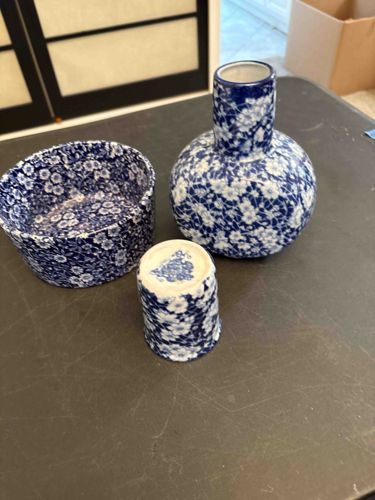
This three-piece ceramic set features a classic 'Calico' or floral chintz design in a deep cobalt blue transfer print against a white ground. The set consists of a globular sake carafe (tokkuri) with a cylindrical neck, a cylindrical drinking cup (ochoko), and a shallow open bowl or basin. The pattern is characterized by a dense, all-over arrangement of small five-petaled white flowers amidst a blue floral network, a style popularized by English potteries such as Burleigh in the late 19th and early 20th centuries. The carafe features a prominent blue band at the rim, while the cup shows the pattern continuing to its base. The visible ceramic body appears to be a heavy earthenware or ironstone common in mid-20th-century production. Condition-wise, the items appear well-preserved with no immediate signs of large chips or cracks, though typical shelf wear is visible on the unglazed foot rings, particularly on the inverted cup. The transfer application is crisp, though slight misalignments are typical of this manufacturing process. This set likely dates from the mid-to-late 20th century, drawing inspiration from Victorian-era English transferware patterns and Japanese functional forms.
AI Appraisal Report

·AI can make mistakes·Verify before acting
Based on my visual examination of this vintage three-piece sake set, I have concluded that it is a mid-to-late 20th-century production, likely of Japanese origin but stylistically inspired by English Staffordshire 'calico' transferware. The set consists of a tokkuri (carafe), ochoko (cup), and a small basin, all featuring a dense cobalt blue floral transfer on a white ground. The condition appears sound; the glaze remains glossy, and the transfer print is remarkably crisp, with only minor shelf wear visible on the unglazed foot rings. There are no obvious chips, cracks, or crazing evident in the images provided. The market for mid-century transferware is stable but generally favors complete dining services over individual novelty sets like this. While the 'Calico' pattern is perennially popular (typically associated with Burleigh in the UK), this specific application on Japanese forms suggests it is export ware or a domestic set influenced by Western aesthetics, which slightly lowers its value compared to authentic 19th-century originals. Comparable sets in this heavy earthenware body typically sell in the $50 range in online marketplaces. It is crucial to note that without physical handling, I cannot definitively determine the specific maker's mark (if present on the underside) or the exact weight of the ceramic body, which would confirm whether this is ironstone or standard earthenware. A physical inspection would also be necessary to detect any professional restoration or hairline fractures invisible to the camera. Currently, the value is driven primarily by its decorative appeal and functional condition rather than significant antique rarity.

Get your items appraised

Instant estimates of your treasures with AI-powered appraisals

Browse More Appraisals