AI Appraisal Estimate

AI-generated estimates · not official valuations

From the user

What was submitted

Photo and notes provided by the user — not generated by AI

Submitted item photo
Submitted photo · June 3, 2026

User's notes

No additional notes provided.

AI analysis below

AI appraisal

AI analysis & estimate

AI-Generated · Verify before acting

Everything below is generated by AI for informational purposes only. AI can make mistakes — the AI may misidentify items or misattribute them (artist, maker, brand, designer, origin, era). This is not an official valuation and should not be used for insurance, sale, tax, estate, legal, or lending purposes — or any decision requiring a certified appraisal. It is not an authoritative claim about any person, brand, or rights holder — do not share or rely on it as a factual statement about a third party. Always consult qualified professionals before making financial decisions.

Read the full disclaimer

AI Identification

·Not independently authenticated·Verify before acting

Johnson Brothers Victorian Ware Ironstone

Antique/Vintage Ceramic Tableware

AI Estimated Value

·Not an official valuation·Verify before acting

$15.00-$35.00

As of June 3, 2026

AI Item Analysis

·AI can make mistakes·Verify before acting
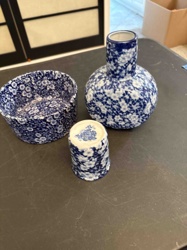
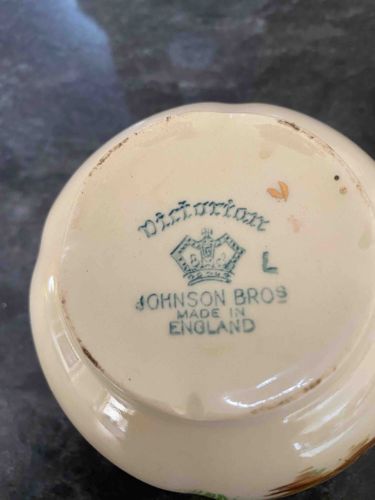
This item is a piece of glazed ceramic ironstone, specifically identified by its prominent green backstamp as part of the 'Victorian' line by Johnson Brothers. The piece features a cream-colored translucent white slip with a rounded, globular body and a slightly raised circular footrim. The underglaze backstamp includes a crown symbol with the initials 'JB' inside, the series name 'Victorian' in a curved gothic font, and the text 'JOHNSON BROS MADE IN ENGLAND' printed in a crisp teal-green ink. A single capital 'L' appears to the right of the crown. Physically, the item shows signs of age-related wear, including dark particulate accumulation (dirt or grease) trapped along the footrim groove and some light staining on the base. There is a visible orange-tinted mark or chip near the top right of the base, potentially a manufacturing blemish or later surface damage. The craftsmanship represents high-quality mid-20th-century British mass-production earthenware, known for its durability. Based on the specific style of the mark, this piece likely dates to the post-1913 era, possibly mid-1940s to 1950s. The smooth glaze finish and heavy ceramic body are characteristic of traditional Staffordshire pottery.
AI Appraisal Report

·AI can make mistakes·Verify before acting
Based on my visual examination of the backstamp and physical characteristics, this piece is an authentic example of Johnson Brothers 'Victorian' ware, produced in the Staffordshire region of England. The teal underglaze mark, featuring the crown and 'JB' initials, is consistent with production dating from the mid-20th century. The ironstone body exhibits the expected weight and creamy slip typical of this era. Regarding condition, I observed significant particulate buildup along the footrim and surface staining. The orange-tinted mark noted near the base likely represents a 'stilt mark' or a minor glaze pop from the kiln, though it could also indicate a small chip; such imperfections are common in mass-produced earthenware but do detract slightly from the value for a mint-condition collector. The market for Johnson Brothers ironstone remains steady but saturated. This 'Victorian' pattern is valued more for its utility and classic aesthetic than for extreme rarity. Comparables for individual serving pieces or basics in this line typically clear at auction or secondary markets in the twenty-to-thirty dollar range. Factors affecting value include the presence of crazing (not visible here but common) and the specific vessel type—larger tureens or platters fetching higher premiums than small bowls or plates. Limitations: This appraisal is based solely on digital imagery. To provide a definitive authentication and internal integrity check (specifically for 'hairline' cracks not visible to the eye), an in-person 'ring test' and a blacklight examination would be required to rule out professional restorations. Formal provenance or original sales receipts would further solidify its history.

Get your items appraised

Instant estimates of your treasures with AI-powered appraisals

Browse More Appraisals