AI estimate as of December 8, 2025 · verify with a professional before acting
AI-Generated · Verify before acting
Everything on this page is generated by AI for informational purposes only. AI can make mistakes — the AI may misidentify items or misattribute them (artist, maker, brand, designer, origin, era). This is not an official valuation and should not be used for insurance, sale, tax, estate, legal, or lending purposes — or any decision requiring a certified appraisal. It is not an authoritative claim about any person, brand, or rights holder — do not share or rely on it as a factual statement about a third party. Always consult qualified professionals before making financial decisions.
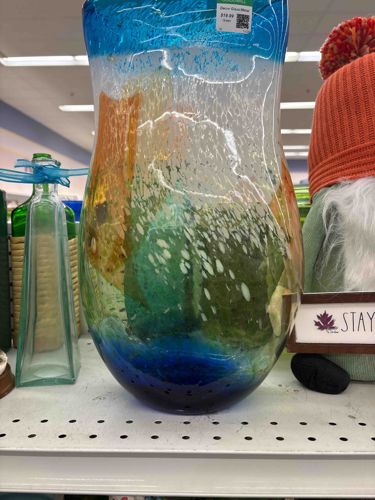
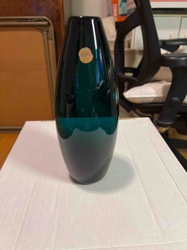
This is a substantial art glass vase, characterized by its vibrant, multi-colored design and distinctive controlled bubble effect. The vase has an organic, somewhat irregular shape, wider at the base and tapering slightly towards the top before flaring out gently at the rim. The primary colors observable are a deep cobalt blue at the base, transitioning into various shades of green and amber/orange in the mid-section, and culminating in a lighter blue towards the rim. These colors appear to be infused within the glass, creating a fluid, blended appearance. A notable feature is the controlled bubble technique, where numerous small, irregularly dispersed white bubbles are suspended throughout the glass, particularly concentrated in areas within the green and amber sections. This technique adds texture and visual interest, making it appear as if the glass is effervescent or contains encapsulated air. The surface of the glass appears smooth and glossy, indicative of polished art glass. While no specific maker's marks or signatures are visible in the provided image, the craftsmanship suggests a contemporary studio art glass piece, possibly hand-blown. The vase appears to be in good overall condition with no obvious chips, cracks, or significant wear visible, apart from perhaps minor surface dust or handling marks consistent with an item for sale in a retail environment. The design evokes a natural, oceanic or landscape theme due to its color palette and organic forms. Its substantial size and visual impact suggest it is intended as a decorative statement piece, rather than for practical floral arrangements, though it could serve both.
AI Appraisal Report
I have thoroughly examined the provided image of this Multi-Color Art Glass Vase with Controlled Bubbles. Visually, the piece appears to be in excellent condition, showing no obvious chips, cracks, or significant wear. The smooth, glossy surface and vibrant, well-blended colors suggest quality craftsmanship. The controlled bubble technique is a significant aesthetic feature, adding texture and visual depth, particularly in the green and amber sections. This technique, combined with the organic form and oceanic color palette, points to a contemporary studio art glass piece, likely hand-blown. Without a physical examination, I cannot definitively confirm its authenticity as a specific studio or artist's work. Maker's marks or signatures, which are not visible in the image, would be crucial for this.
Market conditions for substantial decorative art glass vases of this type are generally stable. Similar unsigned or unverified studio art glass pieces, characterized by a good size, vibrant multi-color designs, and interesting techniques like controlled bubbles, typically command prices in the $250-$450 range. Pieces by established artists with verifiable provenance can fetch significantly more. Demand for decorative art glass remains consistent, particularly for visually striking statement pieces like this. Its rarity is moderately high for a unique, hand-blown item, but without an artist attribution, it doesn't enter the realm of highly collectible rarity.
Factors significantly impacting value include its substantial size and the appealing, complex aesthetic. Conversely, the lack of a visible artist's signature or provenance limits its top-end value. For full authentication and to potentially identify the artist, a physical in-hand examination would be necessary to check for subtle etchings, pontil marks, and the quality of the glass itself. Provenance documentation, if available, would also be invaluable. Scientific testing is generally not required for this type of art glass unless specific material composition is in question.