AI estimate as of December 4, 2025 · verify with a professional before acting
AI-Generated · Verify before acting
Everything on this page is generated by AI for informational purposes only. AI can make mistakes — the AI may misidentify items or misattribute them (artist, maker, brand, designer, origin, era). This is not an official valuation and should not be used for insurance, sale, tax, estate, legal, or lending purposes — or any decision requiring a certified appraisal. It is not an authoritative claim about any person, brand, or rights holder — do not share or rely on it as a factual statement about a third party. Always consult qualified professionals before making financial decisions.
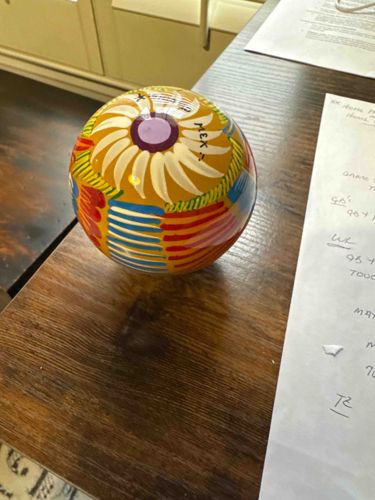
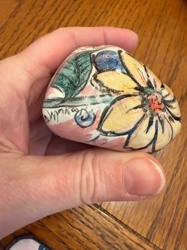
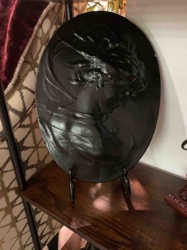
This is a vibrantly decorated ceramic sphere, likely intended as a decorative accent piece. It features a bright, glossy finish that suggests it might be glazed or lacquered. The dominant color on the top segment of the sphere is a rich, golden yellow, adorned with a large, stylized daisy-like flower in the center. The flower has a deep purple or maroon center ring, an outer ring of light purple, and numerous white or cream-colored petals with thin yellow outlines. Surrounding this central floral motif are radial yellow lines. The lower half of the sphere is divided into multiple geometric segments, each filled with distinct patterns and colors. These include sections with horizontal stripes in red, orange, and blue, as well as areas featuring small, multicolored squares or dots. The color palette is rich and diverse, utilizing primary and secondary colors such as red, orange, yellow, blue, green, and purple. The craftsmanship appears to be hand-painted, displaying a charming, folk art quality. Visible markings on the upper central yellow area include the partial word "MEX" likely indicating "Mexico" and a symbol or letter (possibly 'A') further along. The sphere appears to be in good condition with a consistent sheen, suggesting minimal wear or damage. Its construction is solid, indicative of traditional pottery techniques. The overall aesthetic points to a lively, perhaps cultural or celebratory theme, common in Mexican crafts. Its style appears to be contemporary folk art, possibly dating from the late 20th or early 21st century. The quality of painting showcases a steady hand and attention to detail, characteristic of artisan work.
AI Appraisal Report
Upon visual examination of the provided images, this hand-painted ceramic sphere presents as a fine example of contemporary Mexican folk art. The piece is in excellent condition, with a vibrant, glossy glaze and no apparent chips, cracks, or significant wear. The painting is detailed and skillfully executed, showcasing a rich color palette and a blend of floral and geometric motifs characteristic of a celebratory, artisanal style. The visible marking 'MEX' strongly suggests its origin is Mexico, which aligns with its aesthetic. This type of decorative ceramic is a popular and widely produced craft in Mexico, often sold in tourist markets and artisan shops.
The market for such items is generally stable, with a broad collector base for Mexican folk art. However, the value is heavily influenced by the artist's renown, the specific workshop, and overall artistic execution. While well-crafted, this sphere appears to be an unattributed artisan piece rather than the work of a highly collectible master ceramicist. Its value is therefore primarily decorative. Comparables from online marketplaces and auctions for similar unsigned, contemporary Mexican ceramic spheres typically fall within the $40 to $80 range, depending on size and complexity.
My valuation is limited by the inability to physically inspect the piece. An in-person examination would be required to assess the weight and quality of the clay body, look for hidden maker's marks or signatures, and confirm there are no hairline cracks or restorations not visible in photos. Full authentication would benefit from any provenance documentation linking it to a specific artist or workshop. Without such information, it is appraised as a high-quality, decorative artisan piece.