AI estimate as of October 26, 2025 · verify with a professional before acting
AI-Generated · Verify before acting
Everything on this page is generated by AI for informational purposes only. AI can make mistakes — the AI may misidentify items or misattribute them (artist, maker, brand, designer, origin, era). This is not an official valuation and should not be used for insurance, sale, tax, estate, legal, or lending purposes — or any decision requiring a certified appraisal. It is not an authoritative claim about any person, brand, or rights holder — do not share or rely on it as a factual statement about a third party. Always consult qualified professionals before making financial decisions.
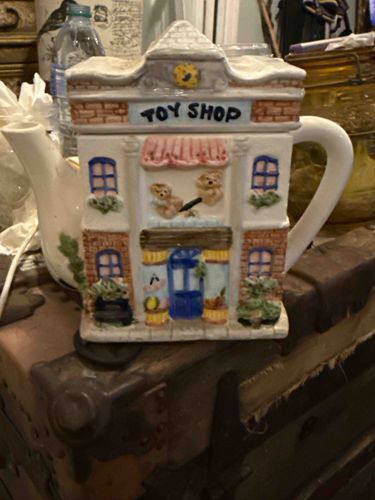
This item is a novelty teapot designed in the shape of a two-story building facade, resembling a 'Toy Shop'. The teapot is crafted from ceramic, likely porcelain or earthenware, and features hand-painted details. Its primary colors include white for the building's main walls, accented with brick-red for architectural elements, blue for window frames and doors, pastel pink for an awning, and various shades of green for foliage. The construction appears to be molded ceramic with applied decorative details. Key features include the prominent 'TOY SHOP' sign above the first-floor windows, a pink scalloped awning over a display window, and two small, three-dimensional teddy bears peeking out from behind a pane in the window. Below the sign, a round, yellow element with a darker center (possibly a clock or decorative medallion) is visible. The lower-level facade includes a blue double door entrance, flanked by display windows and small planters with green foliage. The teapot handle is integrated into the right side of the building, continuing the white ceramic, while the spout is on the left, protruding from the side of the 'building'. The roofline is textured to mimic shingles, colored in a light gray/white. The overall design suggests a whimsical and charming aesthetic, often associated with cottage ware or decorative kitchenware from the late 20th century. There are no obvious signs of significant damage like chips or cracks apparent from the image, but specific condition details like crazing, paint loss, or repairs cannot be definitively assessed without closer inspection. The craftsmanship indicates a mass-produced decorative item, prioritizing aesthetic appeal over fine porcelain quality, though the hand-painting adds a touch of individuality. The item likely dates from the 1980s to early 2000s, a period popular for such themed teapots.
AI Appraisal Report
I have visually examined this Novelty Teapot - Toy Shop Building. The teapot appears to be in good overall condition with no obvious chips, cracks, or significant paint loss discernible from the image. The ceramic construction, hand-painted details, and whimsical design are characteristic of decorative teapots produced in the late 20th to early 21st century, likely between the 1980s and early 2000s. Authenticity, in this context, refers to its identity as a mass-produced consumer item rather than a fine art or antique piece. Based on visual cues, it appears consistent with such an item; however, without an in-person examination, I cannot confirm the specific ceramic type (e.g., earthenware vs. porcelain), the presence of crazing, minor paint abrasions, or any subtle repairs that might impact its condition assessment. Markings on the base, if present, would be crucial for identifying the manufacturer, which could slightly influence value for collectors of specific brands. This type of novelty teapot typically falls under the 'cottage ware' or 'decorative kitchenware' category. The market for such items is generally steady but not booming, with demand primarily driven by collectors of novelty teapots or specific themes. While charming, these items are not particularly rare due to their mass-produced nature. Comparable sales for similar themed novelty teapots, especially unbranded ones or those from less prominent manufacturers, typically range in the $25-$50 bracket. Factors impacting value positively would be exceptional condition, original packaging (if applicable), or a connection to a highly sought-after brand. Conversely, any condition issues not visible in the image, such as crazing, significant paint wear, or damage, would decrease its value. For a full authentication and detailed condition assessment, physical inspection, including viewing the base for maker's marks and assessing the glaze and paint under magnification, would be necessary.