AI estimate as of October 7, 2025 · verify with a professional before acting
AI-Generated · Verify before acting
Everything on this page is generated by AI for informational purposes only. AI can make mistakes — the AI may misidentify items or misattribute them (artist, maker, brand, designer, origin, era). This is not an official valuation and should not be used for insurance, sale, tax, estate, legal, or lending purposes — or any decision requiring a certified appraisal. It is not an authoritative claim about any person, brand, or rights holder — do not share or rely on it as a factual statement about a third party. Always consult qualified professionals before making financial decisions.
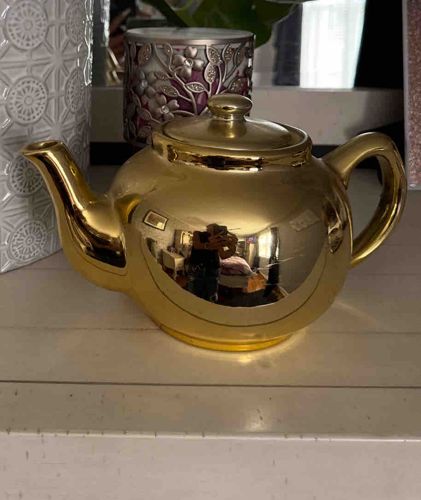
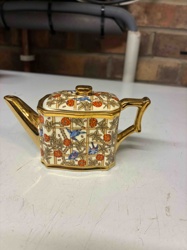
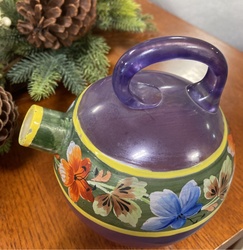
This item is a decorative teapot, likely constructed from ceramic or porcelain, featuring a highly reflective and polished gold-colored finish. The teapot has a classic, rounded silhouette with a gracefully curved spout and a C-shaped handle, both proportional to the body. A fitted lid, topped with a small, spherical finial, sits snugly on the opening. The surface exhibits a mirror-like quality, reflecting its surroundings, including what appears to be an interior room with furniture. While the material is not definitively discernible from the image, the uniformity of the gold coating suggests it is either a metallic glaze or a form of electroplating over a ceramic base. There are no visible chips, cracks, or significant abrasions on the surface, indicating either excellent preservation or careful handling. The reflective nature makes it difficult to assess minor imperfections, but the overall presentation is clean and bright. There are no apparent maker's marks or distinguishing engravings visible in the provided image. Its style leans towards contemporary decorative art, rather than a traditional functional teapot, given its highly stylized, opulent finish. The quality appears good, with a smooth, even application of the gold finish and well-formed components, suggesting it is a mass-produced decorative item rather than a handcrafted artisan piece. Its primary function would likely be as an ornamental piece for display rather than for actual tea service.
AI Appraisal Report
Upon visual examination of the provided image, I assess this gold-finished ceramic teapot as a decorative item in excellent condition. There are no visible chips, cracks, or abrasions, and the gold finish appears uniform and highly reflective. Authenticity as a genuine ceramic piece with metallic glazing seems likely given the polished appearance, but without physical inspection, I cannot definitively confirm its construction material (e.g., ceramic vs. resin) or the exact application method of the gold finish (e.g., electroplating, metallic paint). It appears to be a mass-produced contemporary decorative item rather than an antique or handmade artisan piece, lacking any discernible maker's marks.
Market conditions for purely decorative, mass-produced teapots of this style are generally stable but do not command high prices. Comparable items, often found in home decor stores or online marketplaces, typically retail in the $30-$70 range, sometimes higher if marketed by a well-known decor brand. Demand for such items is largely driven by aesthetic appeal and current interior design trends, rather than rarity or intrinsic material value. This piece does not exhibit any characteristics that would suggest significant rarity. The primary value drivers are its pristine condition and attractive, opulent finish.
Limitations in authenticity verification are significant due to the image-only examination. To fully authenticate the material, confirm the finishing technique, and ascertain if any maker's marks exist (perhaps on the base not visible), an in-person examination would be crucial. Provenance documentation could potentially identify the manufacturer or brand, further refining value, but is unlikely to exist for such decorative items. Scientific testing, such as elemental analysis, would be necessary to confirm the metallic composition of the finish, though this level of testing is generally reserved for higher-value art or antique objects.