AI estimate as of October 30, 2025 · verify with a professional before acting
AI-Generated · Verify before acting
Everything on this page is generated by AI for informational purposes only. AI can make mistakes — the AI may misidentify items or misattribute them (artist, maker, brand, designer, origin, era). This is not an official valuation and should not be used for insurance, sale, tax, estate, legal, or lending purposes — or any decision requiring a certified appraisal. It is not an authoritative claim about any person, brand, or rights holder — do not share or rely on it as a factual statement about a third party. Always consult qualified professionals before making financial decisions.
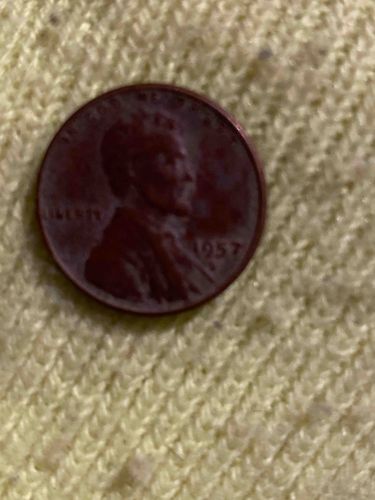
The item is a United States one-cent coin, commonly known as a penny, specifically identified as a Lincoln Wheat Cent due to the visible obverse design. The coin appears to be made of copper, exhibiting a reddish-brown color with significant darkening and apparent toning or environmental damage that has obscured some of the finer details. The image shows the obverse side of the coin, featuring a right-facing bust of Abraham Lincoln. Above Lincoln's head, the inscription 'IN GOD WE TRUST' is partially visible, though heavily worn. To Lincoln's left, the word 'LIBERTY' is discernible, also showing wear. The date '1957' is clearly legible to Lincoln's right. The raised details of Lincoln's portrait are flattened, indicating considerable circulation wear. There are no clear mint marks immediately visible in the provided image. The surface of the coin appears non-uniform with darker patches and possible areas of corrosion or accumulated grime, particularly around the perimeter and within the recessed areas of the design. The rim of the coin seems relatively intact but is also affected by the overall darkening. The condition suggests that this coin has been in circulation for a long period and has not been preserved in a protective environment. This coin belongs to the 'Wheat Penny' series, which was minted from 1909 to 1958, making its estimated age 67 years old as of 2024. The general craftsmanship aligns with mass-produced coinage of the mid-20th century.
AI Appraisal Report
Based on my visual examination of the provided image, this 1957 Lincoln Wheat Cent appears to be a genuine United States one-cent coin. The obverse design, including the bust of Lincoln, the legible date '1957', and the partial inscriptions 'IN GOD WE TRUST' and 'LIBERTY', are consistent with known examples of this issue.
The coin's condition is heavily circulated, presenting as 'Good' (G) to 'Very Good' (VG) on the Sheldon scale. There is significant wear evident on Lincoln's portrait, with flattened details. The surface exhibits substantial darkening, toning, and what appears to be environmental damage or grime, particularly around the perimeter. This wear and surface degradation significantly impact its numismatic value.
Regarding market conditions, the 1957 Lincoln Wheat Cent is an extremely common coin, with millions minted. It is neither rare nor in high demand among collectors in this circulated condition. Comparables for a 1957-P (no mint mark, indicating Philadelphia) in G-VG condition typically trade for very little above face value. Factors significantly impacting its low value include its common mintage, the heavy wear, and the apparent surface deterioration. No mint mark is visible, which is standard for a 1957 Philadelphia strike and does not add rarity.
It is important to note that this appraisal is based solely on visual examination of the provided image. While the authenticity appears clear from the design, a definitive authentication would require an in-person examination to assess the coin's weight, diameter, and metallic composition. Scientific testing such as spectroscopy could confirm the alloy. Furthermore, a physical inspection would allow for a more precise grading of its condition, enabling a clearer distinction between wear, toning, and potential environmental damage or cleaning effects that might be masked by the image quality.