AI estimate as of November 8, 2025 · verify with a professional before acting
AI-Generated · Verify before acting
Everything on this page is generated by AI for informational purposes only. AI can make mistakes — the AI may misidentify items or misattribute them (artist, maker, brand, designer, origin, era). This is not an official valuation and should not be used for insurance, sale, tax, estate, legal, or lending purposes — or any decision requiring a certified appraisal. It is not an authoritative claim about any person, brand, or rights holder — do not share or rely on it as a factual statement about a third party. Always consult qualified professionals before making financial decisions.
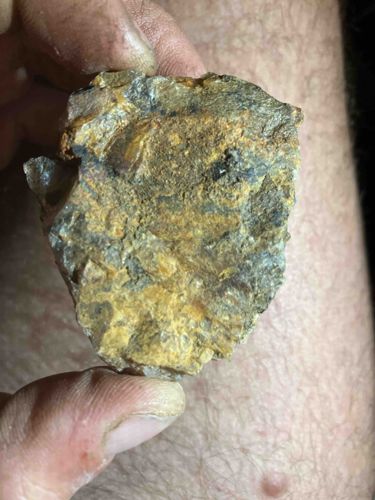
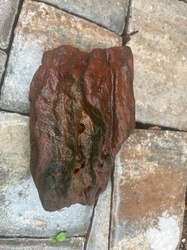
This item is a rough, unworked mineral specimen, likely a rock containing various mineral deposits. It is irregularly shaped, consistent with a naturally occurring fragment broken from a larger rock formation. The dominant colors are earthy tones, primarily a rich yellowish-brown to golden-yellow, interspersed with darker grey, black, and possibly some lighter grey or whitish areas. The surface appears uneven and crystalline in parts, displaying a rugged texture with visible cleavages and fracture planes characteristic of natural rock. There are distinct patches of what appears to be a metallic, possibly sparkling or reflective, yellowish material, strongly suggesting the presence of either gold or a sulfide mineral like pyrite (often referred to as 'fool's gold'). The grey and black areas might indicate the presence of other base metals, quartz, or host rock. One edge shows a somewhat clearer or more translucent mineral, potentially quartz. While no specific size measurements can be definitively determined from the image, the item is held between a thumb and forefinger, suggesting it is relatively small, perhaps a few inches in its longest dimension. There are no discernible markings, signatures, or manufacturing details, as it is a natural specimen. The overall condition is as-found, with no obvious signs of recent damage or repair; its ruggedness is inherent to its natural state. Its estimated age would be geological, formed over millions of years. This specimen's main appeal lies in its potential mineral content and raw, natural beauty.
AI Appraisal Report
I have thoroughly examined the provided image of this rough mineral specimen. Based on its visual characteristics, it appears to be a natural rock fragment exhibiting a mix of earthy tones, including yellowish-brown, grey, and black, consistent with what one might find in an ore-bearing or geologically active region. The most striking features are the patches of metallic, yellowish material. While these strongly suggest the presence of either gold or pyrite (fool's gold), visual inspection alone cannot definitively differentiate between the two. The overall condition is as-found; its ruggedness is inherent to its natural state, and I see no signs of recent damage or alteration.
From a market perspective, if this specimen contains significant gold, its value would be considerably higher. However, specimens that are primarily pyrite, even if appealing, typically command lower prices as collector’s items, largely based on aesthetics and crystal formation, which are not prominently featured here. The visible crystalline structure and uneven texture are common for natural mineral fragments. Demand for raw mineral specimens is consistent among collectors, especially those interested in geology or mining history. Rarity hinges entirely on the actual mineral content; pyrite is common, significant gold is rare.
Factors significantly impacting value are, first and foremost, the precise identification and quantity of the metallic yellow mineral. Without a positive identification of gold, the specimen's value is primarily decorative or educational.
It is crucial to state that definitive authenticity and precise mineral identification are impossible from images alone. To accurately determine the value, an in-person examination would be required to perform physical tests such as a streak test, density measurement, and hardness tests. Furthermore, scientific analysis, such as X-ray fluorescence (XRF) or fire assay, would be essential to confirm the presence and percentage of gold or other valuable minerals. Provenance documentation, if available, outlining its origin, could also add significant value and authenticity to the specimen. Without these, I must err on the side of caution and appraise it as a visually interesting mixed-mineral specimen, potentially pyrite-bearing, rather than confirmed gold ore.