AI estimate as of October 18, 2025 · verify with a professional before acting
AI-Generated · Verify before acting
Everything on this page is generated by AI for informational purposes only. AI can make mistakes — the AI may misidentify items or misattribute them (artist, maker, brand, designer, origin, era). This is not an official valuation and should not be used for insurance, sale, tax, estate, legal, or lending purposes — or any decision requiring a certified appraisal. It is not an authoritative claim about any person, brand, or rights holder — do not share or rely on it as a factual statement about a third party. Always consult qualified professionals before making financial decisions.
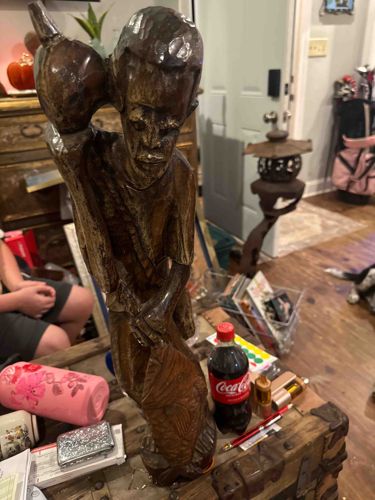
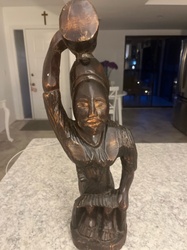
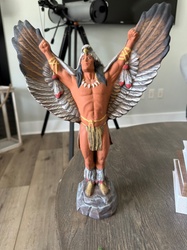
This is a hand-carved wooden figure depicting a standing male individual, likely a water carrier, holding a large, narrow-necked vessel on his left shoulder. The figure is rendered in a dark brown, possibly stained, wood with visible grain patterns throughout, indicating it was carved from a single piece or carefully joined pieces of timber. The carving style appears somewhat rustic and folk-art inspired, exhibiting simplified features and a focus on gesture and form rather than intricate detailing.
The man is depicted with a lean build, his head slightly tilted forward, suggesting effort or contemplation. His facial features, though basic, show carved eyes, a nose (partially obscured by shadow), and a mouth. The hair is represented by carved lines on the top of the head. The torso is slender, and the clothing is suggested through carved lines and folds, particularly around the collar and sleeves. The vessel he carries is robust and has a distinctive shape with a rounded body and a long, slender neck and spout. The figure's left arm is raised to support the vessel, while the right arm is bent, possibly holding something or resting by his side (partially obscured). The lower half of the figure shows detailed carving, possibly depicting fabric or an animal (a bird or fish is suggested by the feathery/scaly texture and eye-like prominence near the bottom front), which would indicate a more complex narrative or symbolic element. The base of the figure is integrated into the carving, providing stability.
Observable condition issues include some surface wear, minor nicks, and possibly some dust accumulation. There are no obvious major cracks, repairs, or significant damage visible in the provided images, though a thorough inspection would be needed to confirm. The piece likely dates from the mid to late 20th century, consistent with artisanal or tourist carvings. The craftsmanship suggests a skilled artisan, using traditional carving techniques, even if the style is not highly refined. The luster on the surface of the wood could be from a natural patina, wax, or a lacquered finish.
AI Appraisal Report
Based on my visual examination of the provided image, this hand-carved wooden figure of a man carrying a vessel, or 'Water Carrier,' appears to be a piece of folk art, likely dating from the mid to late 20th century. The carving style is rustic and expressive, focusing on the character's posture and the narrative of carrying a heavy load. The dark brown wood exhibits visible grain, consistent with a stained or naturally patinated timber. Condition appears good for its age, with expected surface wear and minor nicks. I don't observe any major cracks or repairs, but a physical inspection would be crucial to confirm this and assess the stability of the wood, especially for any hairline fractures or older restorations. The suggested intricate carving on the lower half (bird/fish/scale texture) adds an interesting, albeit ambiguous, symbolic element.
Market conditions for such contemporary folk art carvings are generally modest. While beautifully crafted, these pieces often appeal to a niche collector base or those seeking decorative accents. Comparables typically sell in the low to mid-hundreds, depending on size, artist recognition (if any), and overall aesthetic appeal. Demand is steady but not high, as these are not considered rare antiques. Factors impacting value include the quality of the carving, the condition, and any identifiable artist or origin. Without an artist's signature or provenance, it's valued primarily as a decorative object.
Limitations in authenticity verification are significant. From an image alone, I cannot definitively determine the exact wood species, the presence of any concealed repairs, or the precise age. A physical examination would allow me to assess the tool marks, confirm the type of finish, and conduct a more thorough condition report. Provenance documentation, if available, would significantly enhance value, particularly if it pointed to a recognized folk artist or specific cultural origin.