AI Appraisal Estimate

AI-generated estimates · not official valuations

From the user

What was submitted

Photo and notes provided by the user — not generated by AI

Submitted item photo
Submitted photo · June 20, 2026

User's notes

No additional notes provided.

AI analysis below

AI appraisal

AI analysis & estimate

AI-Generated · Verify before acting

Everything below is generated by AI for informational purposes only. AI can make mistakes — the AI may misidentify items or misattribute them (artist, maker, brand, designer, origin, era). This is not an official valuation and should not be used for insurance, sale, tax, estate, legal, or lending purposes — or any decision requiring a certified appraisal. It is not an authoritative claim about any person, brand, or rights holder — do not share or rely on it as a factual statement about a third party. Always consult qualified professionals before making financial decisions.

Read the full disclaimer

AI Identification

·Not independently authenticated·Verify before acting

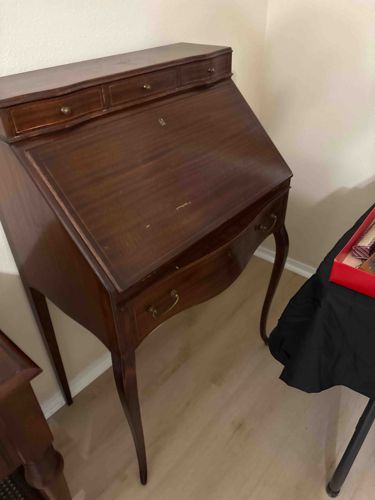
Small George III Style Inlaid Slant-Front Bureau on Stand

Antique & Vintage Furniture

AI Estimated Value

·Not an official valuation·Verify before acting

$450 - $650

As of June 20, 2026

AI Item Analysis

·AI can make mistakes·Verify before acting
This is a small-scale, mahogany slant-front desk (often referred to as a lady’s bureau or secretary) mounted on high, elegant cabriole legs. The piece is constructed with dark-stained mahogany featuring fine light-wood stringing or pinstripe inlay along the drawer fronts and the slant lid, a hallmark of the Hepplewhite or Sheraton revival styles. The top superstructure consists of three small 'box' drawers with petite brass knob pulls, while the lower body features a single serpentine-front drawer with brass bail handles. The slant lid drops down to provide a writing surface; it is equipped with a small brass escutcheon, though the key is not visible. The piece stands on four slender, tapered cabriole legs that lack heavy carving, suggesting a refined, 20th-century interpretation of 18th-century forms. Condition-wise, the desk shows noticeable surface wear, specifically horizontal scratches and abrasions on the center of the slant lid, along with some dings and edge wear consistent with moderate residential use. The finish remains generally consistent but has lost some luster. This item likely dates to the mid-20th century (c. 1940s-1970s), intended for decorative use in hallways or bedrooms due to its narrow footprint and dainty proportions.
AI Appraisal Report

·AI can make mistakes·Verify before acting
I have virtually examined this George III style inlaid slant-front bureau on stand. Based on the construction details and aesthetic features, I have identified this as a high-quality 20th-century revival piece, likely manufactured between 1940 and 1960. While it captures the elegance of Hepplewhite-era proportions, the uniformity of the pinstripe inlay and the specific casting of the brass hardware point toward a modern manufacturing process rather than 18th-century cabinetry. The condition is fair to good; the mahogany retains a rich color, but the significant horizontal abrasions on the fall-front lid and edge wear on the legs notably detract from its immediate aesthetic appeal. In the current secondary market, 'brown furniture' of this scale remains popular for its utility in smaller urban spaces, though prices have softened compared to decades past. Comparables for mid-market revival bureaus of this size typically hammer at auction between $400 and $700 depending on the manufacturer (such as Baker or Kittinger). The value is inhibited by the surface damage, which would require professional conservation to restore 'showroom' luster. Please note that this appraisal is based on photographic evidence only. A physical inspection is necessary to verify joinery techniques (such as dovetail construction), wood species of the secondary interior linings, and the presence of maker's marks or labels which could significantly elevate the provenance and value. Furthermore, I cannot definitively confirm the age of the timber or the originality of the finish without examining the underside and interior drawers for oxidization patterns consistent with the purported age.

Get your items appraised

Instant estimates of your treasures with AI-powered appraisals

Browse More Appraisals