AI Appraisal Estimate

AI-generated estimates · not official valuations

From the user

What was submitted

Photo and notes provided by the user — not generated by AI

Submitted item photo
Submitted photo · June 20, 2026

User's notes

No additional notes provided.

AI analysis below

AI appraisal

AI analysis & estimate

AI-Generated · Verify before acting

Everything below is generated by AI for informational purposes only. AI can make mistakes — the AI may misidentify items or misattribute them (artist, maker, brand, designer, origin, era). This is not an official valuation and should not be used for insurance, sale, tax, estate, legal, or lending purposes — or any decision requiring a certified appraisal. It is not an authoritative claim about any person, brand, or rights holder — do not share or rely on it as a factual statement about a third party. Always consult qualified professionals before making financial decisions.

Read the full disclaimer

AI Identification

·Not independently authenticated·Verify before acting

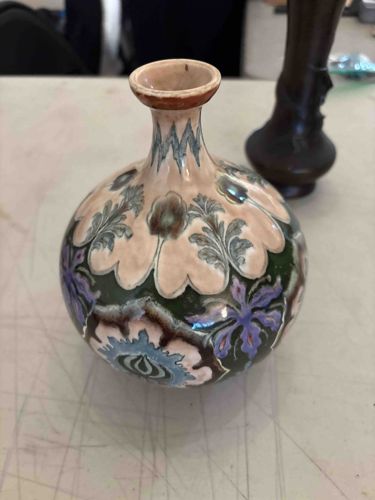
Japanese Satsuma-style Globular Bud Vase

Art Pottery / Collectible Ceramics

AI Estimated Value

·Not an official valuation·Verify before acting

$450 - $650

As of June 20, 2026

AI Item Analysis

·AI can make mistakes·Verify before acting
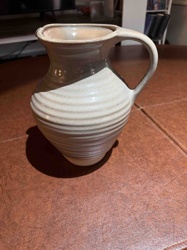
This ceramic bud vase features a squat, globular body with a narrow neck and a flared rim, characteristic of Art Nouveau-influenced Japanese export or European art pottery. The vessel is constructed from a pale cream-colored earthenware or stoneware. The exterior is decorated with a complex, multi-colored lead glaze featuring stylized floral and foliate motifs in shades of olive green, lavender, dusty blue, and chocolate brown. A notable band of scalloped, petal-like shapes encricles the shoulder, containing leafy grey-green sprigs. Below this, large purple flowers and a distinctive blue medallion occupy the main body. The neck is adorned with a blue jagged zig-zag pattern. The glaze shows a high degree of craftsmanship with distinct slip-trailing or tube-lining defining the boundaries between colors. Condition-wise, the piece appears largely intact, though fine crazing is visible throughout the cream glaze, which is typical for pottery of this age (likely late 19th to early 20th century). Minor staining or discoloration is present around the rim and on the interior. There are no obvious chips or cracks visible on the main facade, though some inherent glaze firing irregularities are present.
AI Appraisal Report

·AI can make mistakes·Verify before acting
I have completed a visual examination of this Japanese-inspired Art Nouveau bud vase. The vessel displays the characteristic 'moriage' or slip-trailing technique often associated with export Satsuma-style earthenwares produced during the late Meiji era (approx. 1890–1915). The color palette is particularly sophisticated, utilizing an earthy Art Nouveau transition that sets it apart from more common 'Beidoro' styles. The craftsmanship in the tubelining on the shoulder and the central medallion is excellent, though the fine crazing throughout the glaze is indicative of its earthenware body reacting to environmental fluctuations over time. Market demand for high-quality Japanese export ceramics remains steady, particularly for pieces exhibiting 'East meets West' design aesthetics. Comparables for signed or high-quality unsigned Nippon or Satsuma-style works of this size and complexity typically range between $400 and $800 at specialized auctions. The current condition, showing minor rim staining but no structural losses, supports a mid-range valuation. However, significant limitations exist in an image-based appraisal. To provide a definitive authentication, I would require an in-person inspection to verify the tactile nature of the slip-trailing, check for hidden restorations under UV light, and examine the foot-ring for a maker’s mark or 'Nippon' stamp. The presence of a recognized kiln mark (such as Kinkozan or Yabu Meizan) would exponentially increase this valuation. Until the absence of cracks is verified by a 'ring test' and provenance is established, this value remains an estimate based on visual aesthetic and period-typical characteristics.

Get your items appraised

Instant estimates of your treasures with AI-powered appraisals

Browse More Appraisals