AI Appraisal Estimate

AI-generated estimates · not official valuations

From the user

What was submitted

Photo and notes provided by the user — not generated by AI

Submitted item photo
Submitted photo · May 30, 2026

User's notes

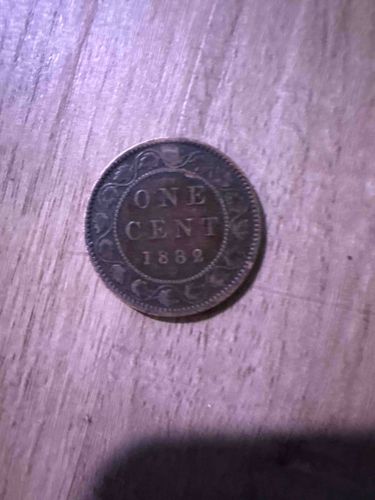
Canadian coin from 1882 Queen Victoria

AI analysis below

AI appraisal

AI analysis & estimate

AI-Generated · Verify before acting

Everything below is generated by AI for informational purposes only. AI can make mistakes — the AI may misidentify items or misattribute them (artist, maker, brand, designer, origin, era). This is not an official valuation and should not be used for insurance, sale, tax, estate, legal, or lending purposes — or any decision requiring a certified appraisal. It is not an authoritative claim about any person, brand, or rights holder — do not share or rely on it as a factual statement about a third party. Always consult qualified professionals before making financial decisions.

Note

This analysis also relies on unverified notes provided by the user, which may be incomplete or inaccurate and could affect the result.

Read the full disclaimer

AI Identification

·Not independently authenticated·Verify before acting

1882 Canadian One Cent Coin (Reverse)

Coin

AI Estimated Value

·Not an official valuation·Verify before acting

$5 - $15

As of May 30, 2026

AI Item Analysis

·AI can make mistakes·Verify before acting
This is an 1882 Canadian One Cent coin, featuring the reverse side of the coin. The coin appears to be made of bronze or copper, displaying a rich, dark brown patina consistent with its age and material. Its circular shape is well-preserved, with a reeded or milled edge visible, although details of the milling are somewhat obscured by wear and the image's resolution. The central design prominently features the denomination 'ONE CENT' stacked vertically, with the year '1882' centered below it. This text is encircled by a decorative wreath or garland, which appears to incorporate maple leaves, characteristic of Canadian coinage, intertwined with what might be grapevines or other floral elements, though specific details are somewhat indistinct due to wear. Another inner ring of decorative beading or dots borders the central motif. The outer rim of the coin features a well-defined raised border, with additional ornamentation, possibly stylized crowns or escutcheons, interspersed with a repeating pattern along the edge. The overall condition suggests moderate to heavy circulation, with significant wear on the raised elements, particularly the finer details of the wreath and the outer rim ornamentation. There is visible surface grime and possibly some minor superficial scratches or pitting consistent with natural aging and handling over more than a century. The luster is absent, replaced by an even, dark patina. The craftsmanship appears standard for period coinage, indicating mass production with good initial detail, now softened by time and use. Given it's a Canadian coin from 1882 featuring Queen Victoria (implied by the context and period), the obverse would typically depict her effigy, which is not visible here.

AI Appraisal Report

·AI can make mistakes·Verify before acting
Based on my examination of the provided image of the 1882 Canadian One Cent coin (reverse) and the owner's details, I can offer a professional appraisal. The coin exhibits significant wear consistent with moderate to heavy circulation, evident in the softened details of the wreath, denomination, and outer ornamentation. The dark brown patina is typical for bronze/copper coins of this age, and while uniform, it has erased any original luster. Surface grime and minor pitting are also visible, further reducing its aesthetic appeal and fine detail. Authenticity, based solely on the image, appears strong. The design elements align with known examples of the 1882 Canadian One Cent. However, full authentication would require in-person examination to verify metal composition, weight, diameter, and edge details against mint specifications. Provenance documentation, though not provided, would also be invaluable. Market conditions for Canadian Victorian-era pennies are generally stable. While not exceptionally rare, the 1882 mintage is not common in higher grades. This particular coin's condition places it firmly in the 'Good' to 'Very Good' (G-VG) range on the Sheldon scale. Comparables in similar circulated condition typically fetch modest prices. Factors significantly impacting its value include the heavy wear, absence of luster, and general surface degradation. Were this coin in a finer grade, such as 'Fine' (F) or 'Very Fine' (VF), its value would increase substantially, given the relative scarcity of high-grade examples.

Get your items appraised

Instant estimates of your treasures with AI-powered appraisals

Browse More Appraisals