AI estimate as of August 14, 2025 · verify with a professional before acting
AI-Generated · Verify before acting
Everything on this page is generated by AI for informational purposes only. AI can make mistakes — the AI may misidentify items or misattribute them (artist, maker, brand, designer, origin, era). This is not an official valuation and should not be used for insurance, sale, tax, estate, legal, or lending purposes — or any decision requiring a certified appraisal. It is not an authoritative claim about any person, brand, or rights holder — do not share or rely on it as a factual statement about a third party. Always consult qualified professionals before making financial decisions.
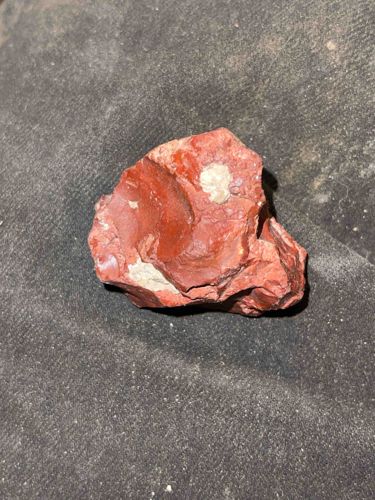
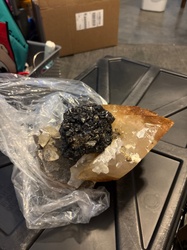
The item is an unfaceted, rough specimen of what appears to be Red Jasper, a common opaque variety of chalcedony, which is a microcrystalline form of quartz. Physically, it is an irregularly shaped, angular rock fragment, consistent with a natural fracture or cleavage pattern. The primary color is a rich, earthy reddish-brown, indicative of high iron content within the mineral. Scattered throughout the reddish matrix are several distinct patches and veins of a lighter, off-white to cream-colored material, likely quartz or another mineral inclusion. The surface texture appears somewhat dull to earthy, with some areas showing a slightly smoother fracture surface and others exhibiting a coarser, more granular appearance. The overall size appears to be small to medium, likely fitting in the palm of a hand. There are no visible signs of polish or intentional shaping, suggesting it is a raw, unworked specimen. No discernible maker's marks, signatures, or stamps are present as expected for a natural mineral specimen. The geological age of Red Jasper formation typically spans millions of years, placing its origin firmly in ancient geological periods. The condition appears to be natural, exhibiting no obvious signs of recent damage, repair, or significant wear beyond what would be expected from natural formation and handling. Its quality is determined by the vibrancy of its color and the clarity of its matrix against inclusions.
AI Appraisal Report
Upon visual examination of the provided image, I assess this Red Jasper Mineral Specimen to be an authentic, unworked example of its kind. The characteristic reddish-brown coloration, indicative of iron content, along with the opaque nature and irregular fracture, aligns perfectly with typical Red Jasper specimens. The lighter inclusions are also common within this chalcedony variety. The surface texture appears consistent with a raw mineral, showing no signs of artificial polishing or shaping.
In terms of condition, it appears natural and stable, with no visible recent damage or repairs. Its quality, judged from the image, is fair; while the reddish hue is present, it lacks the intense, homogenous coloration that would command a premium. The inclusions, while natural, lessen its aesthetic appeal for some collectors.
Market conditions for rough Red Jasper specimens are generally stable, with demand driven by lapidary enthusiasts, crystal collectors, and those interested in metaphysical properties. Red Jasper is not considered rare; it is a very common and abundant mineral. Therefore, its market value is largely based on size, color vibrancy, and aesthetic quality rather than rarity.
Factors significantly impacting its value include its average coloration and the presence of noticeable inclusions. A larger size or a more uniformly vibrant red would increase its desirability and value.
Limitations in authenticity verification from images alone are significant. While it strongly appears to be Red Jasper, without physical examination, I cannot definitively confirm its composition, hardness, specific gravity, or rule out potential treatments. In-person examination would allow for tactile assessment of surface texture, examination under magnification for crystalline structure, and precise measurement. Scientific testing, such as X-ray diffraction or spectroscopy, would be required for absolute mineralogical confirmation. Provenance documentation, although rare for common rough specimens, could provide additional historical context.