AI estimate as of August 25, 2025 · verify with a professional before acting
AI-Generated · Verify before acting
Everything on this page is generated by AI for informational purposes only. AI can make mistakes — the AI may misidentify items or misattribute them (artist, maker, brand, designer, origin, era). This is not an official valuation and should not be used for insurance, sale, tax, estate, legal, or lending purposes — or any decision requiring a certified appraisal. It is not an authoritative claim about any person, brand, or rights holder — do not share or rely on it as a factual statement about a third party. Always consult qualified professionals before making financial decisions.
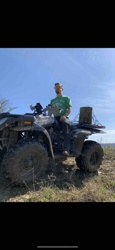
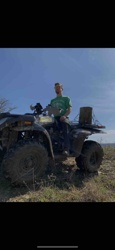
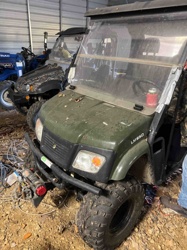
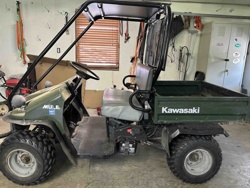
The item is an All-Terrain Vehicle (ATV), specifically a utility or sport-utility model, appearing to be a quad bike due to its four wheels. Its primary color is dark, likely black or a dark shade of green or gray, with visible mud splatters on the body, tires, and undercarriage, indicating recent use in challenging, off-road conditions. The ATV features prominent, knobby off-road tires designed for traction on uneven terrain, and the wheels show some accumulation of mud. There are front and rear utility racks, with the rear rack holding an item possibly secured by a cargo net. The front suspension system, including shock absorbers and control arms, is partially visible and appears robust. The overall construction suggests durability, with various plastic and metal components typical of an ATV. The visible condition includes significant dirt and mud, which is typical for such a vehicle used as intended; however, no obvious damage like dents, cracks, or broken parts are immediately apparent from this view. The ATV appears to be well-maintained despite its muddy state, suggesting it is in operational condition. The design features, such as the headlight configuration and fender styling, are consistent with models produced in the 21st century, likely within the last 10-20 years, though a precise manufacturing date or maker is not discernible due to the angle and mud. The handlebars, seat, and controls are partially visible, indicating a standard ATV layout. The substantial size and rugged appearance suggest it is capable of handling diverse outdoor environments.
AI Appraisal Report
Upon visual examination of the provided image, I assess this ATV to be a utility or sport-utility quad bike. Its condition, while heavily muddied, appears to be operationally sound. The mud splatters are consistent with typical use for such a vehicle, and crucially, I observe no obvious physical damage such as dents, cracks, or broken components. The robust knobby tires and visible suspension components suggest it is well-equipped for off-road use. Authenticity, based on visual cues, points to a genuine ATV, likely manufactured within the last 10-20 years, given its modern design elements like the headlight configuration and fender styling. However, without a clear view of make, model, or VIN, precise authentication beyond a general ATV type is not possible through imagery alone.
Market conditions for used ATVs are generally strong, especially for well-maintained utility models. This ATV's apparent good operational condition, despite its cosmetic dirt, suggests it would be desirable in the secondary market. Comparables would include used Yamaha, Honda, Polaris, or Kawasaki utility ATVs of similar vintage and displacement (which cannot be determined from the image).
Demand for functional ATVs remains consistent, particularly for outdoor recreational activities, farm work, or property maintenance. Rarity is not a factor here; utility ATVs are mass-produced. The primary factors impacting value are the unknown make/model/year, actual engine condition, hours of use, and any hidden mechanical issues not visible.
For full authentication and a more precise valuation, an in-person examination is critical. This would involve a mechanical inspection (engine compression, transmission, brakes, suspension play), verification of the Vehicle Identification Number (VIN) for provenance documentation (e.g., title, service records), and assessment of overall structural integrity and component wear. Scientific testing is not typically applicable for ATV authentication.