AI Appraisal Estimate

AI-generated estimates · not official valuations

From the user

What was submitted

Photo and notes provided by the user — not generated by AI

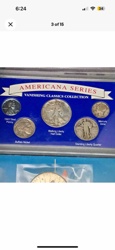
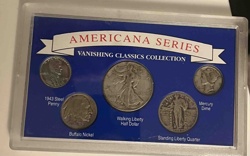
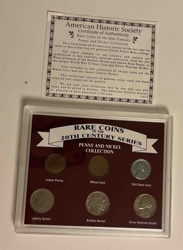
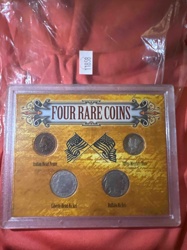
Submitted item photo
Submitted photo · June 27, 2026

User's notes

No additional notes provided.

AI analysis below

AI appraisal

AI analysis & estimate

AI-Generated · Verify before acting

Everything below is generated by AI for informational purposes only. AI can make mistakes — the AI may misidentify items or misattribute them (artist, maker, brand, designer, origin, era). This is not an official valuation and should not be used for insurance, sale, tax, estate, legal, or lending purposes — or any decision requiring a certified appraisal. It is not an authoritative claim about any person, brand, or rights holder — do not share or rely on it as a factual statement about a third party. Always consult qualified professionals before making financial decisions.

Read the full disclaimer

AI Identification

·Not independently authenticated·Verify before acting

Assorted Collection of World Coins

Coin Collection

AI Estimated Value

·Not an official valuation·Verify before acting

$25-50

As of June 27, 2026

AI Item Analysis

·AI can make mistakes·Verify before acting
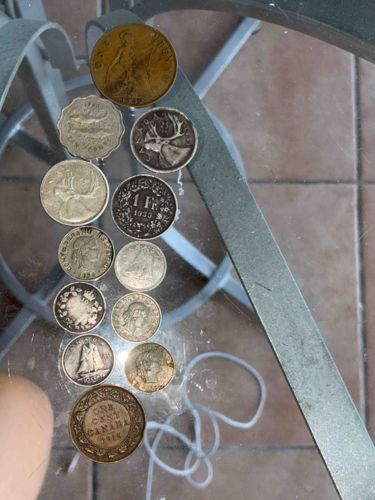
This item is a collection of approximately 14 assorted world coins, ranging in various sizes, metals, and denominations. The coins are laid out on what appears to be a glass or clear plastic surface, possibly a tabletop, over a tiled floor. The collection includes coins from Canada (such as a 'ONE CENT CANADA 1914' coin which shows significant wear and a rich brown patina, and a coin with a caribou/reindeer head), Great Britain (a large bronze-toned coin featuring Britannia, possibly a penny or halfpenny, likely from the early to mid-20th century given its style), and possibly Swiss or other European countries (indicated by a '1 Fr. 1930' coin). Physical characteristics vary. Some coins are silver-toned and appear to be made of silver or a nickel alloy, while others are copper or bronze. The shapes are predominantly round, though one coin, possibly a scalloped-edge Hong Kong coin, stands out with a distinct lobed perimeter. Visible condition issues include significant wear on many of the coins, ranging from surface abrasions and loss of detail (especially on the raised elements) to tarnish and patination appropriate for their age. The 1914 Canadian cent, for example, is well-circulated. The quality of craftsmanship appears standard for circulated coinage of their respective eras, with varying degrees of artistic detail and relief. The group offers a glimpse into early to mid-20th-century numismatics from different nations, showing common currency designs and typical signs of long-term use.
AI Appraisal Report

·AI can make mistakes·Verify before acting
I have virtually examined this collection of approximately 14 assorted world coins. My assessment indicates a variety of circulating issues primarily from the early to mid-20th century. Condition ranges from 'Good' to 'Very Good' or 'Fine' at best for most pieces, with clear signs of circulation such as wear, tarnish, and patination. The Canadian 1914 One Cent is heavily worn, consistent with its age and long circulation. The British Britannia coin also shows significant wear. Authenticity, based solely on visual inspection, appears sound for common circulating coinage; there are no immediate red flags suggesting counterfeits, but this is a limitation of image-based appraisal. The coins appear genuine for their type. Market conditions for common world coins in circulated condition are generally modest. Most of these coins would be considered 'numismatic fillers' or 'starter' pieces for collectors. Demand is moderate, primarily from beginner collectors or those seeking representative examples of world coinage. Rarity is low for the specific coins identifiable (e.g., Canadian cents, Swiss 1 Franc). Factors significantly impacting value are the commonality of the dates and types, and their well-circulated condition. There are no exceptionally rare dates or mint marks apparent, nor any precious metal content significant enough to drive value beyond face or minor numismatic premium (with the possible exception of the '1 Fr. 1930' if it's indeed the silver type, but its condition and specific silver content would need to be confirmed). For full authentication and a more precise valuation, a direct, in-person examination would be essential. This would allow for tactile inspection, detailed measurement, weight verification, and specific gravity tests for metal content, particularly for the silver-toned coins. Access to provenance documentation would also be beneficial, though unlikely for such common circulating issues.

Get your items appraised

Instant estimates of your treasures with AI-powered appraisals

Browse More Appraisals