AI estimate as of July 14, 2025 · verify with a professional before acting
AI-Generated · Verify before acting
Everything on this page is generated by AI for informational purposes only. AI can make mistakes — the AI may misidentify items or misattribute them (artist, maker, brand, designer, origin, era). This is not an official valuation and should not be used for insurance, sale, tax, estate, legal, or lending purposes — or any decision requiring a certified appraisal. It is not an authoritative claim about any person, brand, or rights holder — do not share or rely on it as a factual statement about a third party. Always consult qualified professionals before making financial decisions.
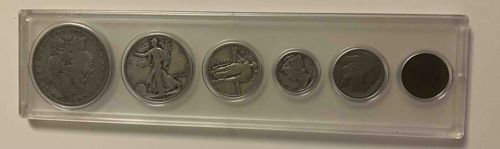
This item is a collection of five U.S. coins, along with one empty slot, housed within a clear acrylic display case. The coins appear to be historical circulating coinage, likely from the early to mid-20th century, given their designs. From left to right, the coins are: 1. A Morgan Silver Dollar (visible obverse with Lady Liberty, circa 1878-1921). It shows moderate wear with details still discernible. 2. A Walking Liberty Half Dollar (visible reverse with eagle, circa 1916-1947). This coin also exhibits signs of wear consistent with circulation. 3. A Standing Liberty Quarter (visible reverse with eagle and stars, circa 1916-1930). Detail loss is apparent on this coin due to circulation. 4. A Mercury Dime (visible obverse with Winged Liberty Head, circa 1916-1945). The features are somewhat subdued, indicating wear. 5. A Buffalo Nickel (visible obverse with Native American profile, circa 1913-1938). The date and some finer details appear worn down, a common issue with this denomination. The sixth slot is empty, suggesting either a missing coin or an intentional placeholder for a future addition, possibly a Lincoln Cent to complete a typical denomination set. All coins are silver-toned, with varying degrees of original luster and patina. No significant damage like deep scratches or corrosion is immediately visible, though surface wear is present on all pieces. The clear acrylic holder is a standard, rigid housing with individual cutouts for each coin, designed to protect them from environmental damage and handling. The clarity of the case allows for easy viewing of both sides of the coins if the case is reversible or the coins are removable. The coins generally appear to be in
AI Appraisal Report
I have carefully examined the provided image of this U.S. Historic Coin Collection in an acrylic holder. The collection comprises five classic U.S. coins: a Morgan Silver Dollar, Walking Liberty Half Dollar, Standing Liberty Quarter, Mercury Dime, and a Buffalo Nickel, with one empty slot. Generally, the coins exhibit heavy to moderate circulation wear. The Morgan Dollar appears to be in Fine to Very Fine condition, while the Walking Liberty Half, Standing Liberty Quarter, and Mercury Dime range from Good to Fine, showing significant wear. The Buffalo Nickel's date is worn, which is typical for this series, placing it likely in a Good or even About Good state. Authenticity, based on the visual attributes typical for these coinage types, appears strong for genuine circulation strikes, though absolute verification requires physical inspection.
Market conditions for these popular classic US coins are generally stable, driven by collector demand for historical artifacts and the intrinsic silver value for the silver coins. While these are common issues, their collective presentation in an acrylic holder adds a level of display appeal. The empty slot suggests an incomplete set, likely awaiting a Lincoln Cent, which slightly diminishes the immediate 'completeness' premium.
Factors significantly impacting value include the condition (which is generally circulated), the silver content for the dollar, half, quarter, and dime, and the desirability of these classic designs. Rarity is not a major factor for coins in this condition; these are widely available.
Limitations in authenticity verification are inherent to image-based appraisals. Full authentication would require in-person examination to check for correct weight, diameter, thickness, edge characteristics, and specific die markers. Scientific testing, such as metallurgy, could confirm composition, and provenance documentation, if available, would provide a more complete historical record.