AI estimate as of October 20, 2025 · verify with a professional before acting
AI-Generated · Verify before acting
Everything on this page is generated by AI for informational purposes only. AI can make mistakes — the AI may misidentify items or misattribute them (artist, maker, brand, designer, origin, era). This is not an official valuation and should not be used for insurance, sale, tax, estate, legal, or lending purposes — or any decision requiring a certified appraisal. It is not an authoritative claim about any person, brand, or rights holder — do not share or rely on it as a factual statement about a third party. Always consult qualified professionals before making financial decisions.
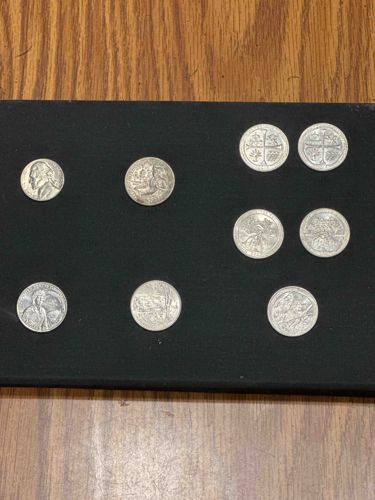
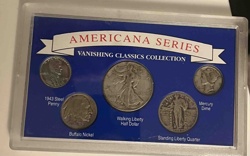
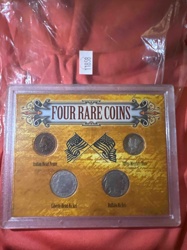
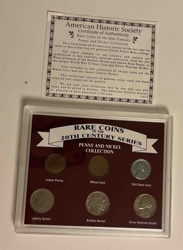
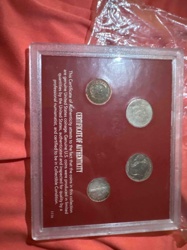
This item consists of a collection of eight silver-colored coins, presumably representing various denominations or commemorative issues, arranged on a black, presumably felt-lined, display tray. The tray appears to be rectangular, with defined circular slots or impressions that securely hold the coins in place. The coins exhibit varying designs. On the left side, two coins are visible in a vertical alignment: the top coin features a profile of a human figure, likely a historical personage such as Thomas Jefferson, indicative of a US nickel. The coin directly below it shows what appears to be a commemorative design with an intricate building or landmark. On the right side, there are two columns of three coins each. The top two coins in the right column feature a design resembling a heraldic cross or a quartered shield, possibly of European origin or an older US issue. The two coins below them in the right column display a nature-inspired design, possibly depicting plant life or wildlife. The bottom right coin displays a similar nature-inspired motif. All coins display a metallic, silvery luster, suggesting they are either made of a silver alloy or a similar base metal. The physical condition of the coins varies; some show visible signs of wear, such as softened details and a duller patina, while others retain sharper features. No specific dates or mint marks are clearly discernible from the image, preventing precise identification of their age or origin beyond general observations. The black display tray aids in presenting the coins, indicating a deliberate collection rather than loose change. The overall presentation suggests a numismatic collection, perhaps intended for display or sale, with a mix of potentially circulating and commemorative coinage.
AI Appraisal Report
I have examined the provided image of this assorted coin collection on a black display. The collection consists of eight silver-colored coins, presented on what appears to be a felt-lined display tray. My assessment of condition and authenticity is based solely on visual inspection of the image, which presents significant limitations.
From the image, the coins display varying degrees of wear. Some exhibit softened details and a duller patina, indicative of circulation or age, while others appear to retain sharper features. The topmost left coin strongly resembles a US nickel, possibly a Jefferson nickel. The other coins are less identifiable from the image; they range from commemorative-style designs to heraldic and nature-inspired motifs. Their metallic luster suggests a silver alloy or a similar base metal, which could include clad coinage.
Market conditions for assorted coin collections like this are highly dependent on the specific coins included. Without clear identification of dates, mint marks, and specific denominations, it is difficult to ascertain rarity or significant demand. Many silver-colored coins, especially post-1964 US coinage or foreign base metal coins, have limited numismatic value beyond their face value or melt value for their base metal composition, which for clad coins is negligible. If any of these coins were indeed pre-1965 US silver issues (dimes, quarters, half-dollars) or true silver foreign coinage, their value would be significantly higher, driven by silver content.
The most significant factors impacting value here are the unknown identity of the coins themselves and their specific metal composition. If these are common modern coins, their value would be minimal. If they contain substantial silver content or are rare numismatic pieces, the value would increase dramatically. The display tray adds presentation value but little intrinsic monetary worth.
Limitations in authenticity verification from images alone are substantial. Precise identification of the coins, including their country of origin, denomination, date, and mint mark, is impossible. Without this information, determining intrinsic metal value, numismatic rarity, and hence, true market value, is speculative. For full authentication and accurate valuation, a physical in-person examination would be essential. This would involve assessing each coin individually, verifying its metal composition (e.g., using a sigma metalytics verifier or specific gravity test), checking for errors, and precisely identifying all relevant markings. Provenance documentation, if available, could also shed light on their origin and historical significance, further impacting value.