AI estimate as of September 8, 2025 · verify with a professional before acting
AI-Generated · Verify before acting
Everything on this page is generated by AI for informational purposes only. AI can make mistakes — the AI may misidentify items or misattribute them (artist, maker, brand, designer, origin, era). This is not an official valuation and should not be used for insurance, sale, tax, estate, legal, or lending purposes — or any decision requiring a certified appraisal. It is not an authoritative claim about any person, brand, or rights holder — do not share or rely on it as a factual statement about a third party. Always consult qualified professionals before making financial decisions.
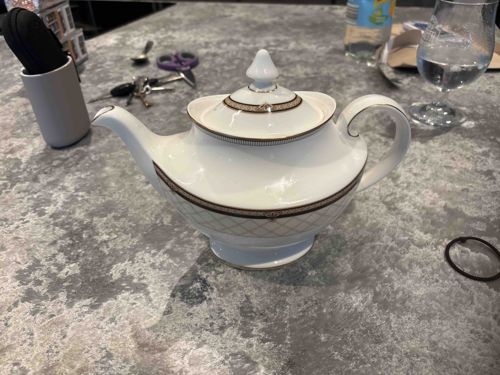
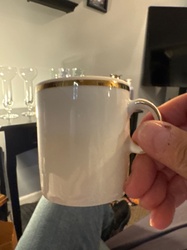
This is a white porcelain teapot, exhibiting a classic, somewhat elegant form. Its primary color is a clean, glossy white, indicative of fine porcelain. The teapot features a rounded body, tapering gracefully towards the bottom to a small, circular footed base, and subtly widening towards the top before the lid opening. The spout is curved and fairly slender, extending outwards from the lower part of the body, while the handle on the opposite side is a C-shaped loop, integrated smoothly into the main body. A distinguishing feature is the decorative banding, which appears to be a muted gold or brown color, with intricate geometric patterns. There are two main bands: one around the base of the lid, featuring a series of small, interconnected diamonds or squares, and another, broader band encompassing the upper half of the teapot's body, which also displays a similar, finely detailed geometric pattern, possibly a lattice or crosshatch design. The lid is domed with a finial that echoes the teapot's overall tapering style, also topped with decorative banding. The rim of the lid and the top edge of the teapot where the lid sits have a thin, contrasting line, likely gilded. The overall impression is one of sophistication. No obvious chips, cracks, or significant wear are visible from the provided image, suggesting it is in good, used condition. The quality of craftsmanship appears high, with smooth surfaces and well-defined decorative elements, though specific maker's marks or signatures are not discernible. The style suggests it could be a modern piece designed to evoke classic tea service aesthetics, possibly from the mid to late 20th century or early 21st century.
AI Appraisal Report
Based on my visual examination of the provided image, this white porcelain teapot with geometric banding appears to be in very good, used condition. I observe no obvious chips, cracks, or significant wear. The glossy white porcelain presents well, and the detailed geometric banding, which appears to be a muted gold or brown, is crisp and intact. The overall design suggests a piece intended to evoke classic tea service aesthetics, likely from the mid-to-late 20th century or early 21st century.
From a market perspective, comparable modern or vintage decorative porcelain teapots, especially those without significant provenance or highly sought-after brand names, typically retail in the $50-$150 range. The decorative banding adds to its aesthetic appeal and might slightly increase its desirability for collectors of specific styles, but does not indicate extreme rarity. Demand for decorative teapots remains steady, though not exceptionally high for pieces of this nature without definitive artist or manufacturer attribution.
Limitations regarding authenticity and definitive dating are inherent when appraising from images alone. While the craftsmanship appears good, an in-person examination would be crucial to verify the quality of the porcelain, identify any subtle flaws not visible in the image, or locate potential maker's marks or signatures that would significantly impact value. For full authentication and more precise dating, physical inspection is essential. This would allow for examination of the glaze, body characteristics, and any potential factory stamps or artist initials. Without such an inspection or provenance documentation, the authenticity of its exact age or origin beyond general stylistic cues cannot be definitively confirmed.