AI Appraisal Estimate

AI-generated estimates · not official valuations

From the user

What was submitted

Photo and notes provided by the user — not generated by AI

Submitted item photo
Submitted photo · June 12, 2026

User's notes

No additional notes provided.

AI analysis below

AI appraisal

AI analysis & estimate

AI-Generated · Verify before acting

Everything below is generated by AI for informational purposes only. AI can make mistakes — the AI may misidentify items or misattribute them (artist, maker, brand, designer, origin, era). This is not an official valuation and should not be used for insurance, sale, tax, estate, legal, or lending purposes — or any decision requiring a certified appraisal. It is not an authoritative claim about any person, brand, or rights holder — do not share or rely on it as a factual statement about a third party. Always consult qualified professionals before making financial decisions.

Read the full disclaimer

AI Identification

·Not independently authenticated·Verify before acting

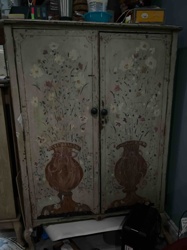
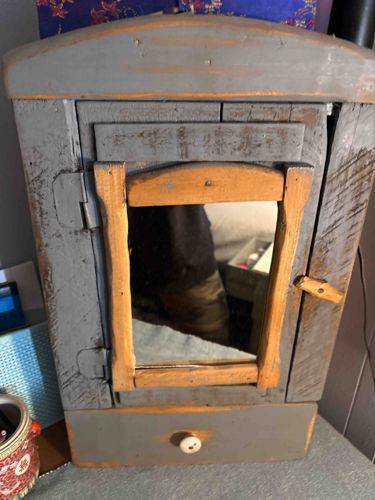
Vintage Folk Art Wall-Mount Medicine Cabinet

Antique/Vintage Furniture & Folk Art

AI Estimated Value

·Not an official valuation·Verify before acting

$250 - $450

As of June 12, 2026

AI Item Analysis

·AI can make mistakes·Verify before acting
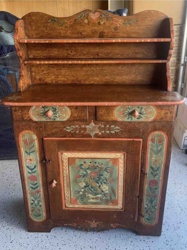
This is a rustic, folk-art style wall cabinet featuring a central mirrored door and a single bottom drawer. The piece is constructed from solid wood planks, likely pine or another common softwood, and displays a prominent grey painted finish with natural wood accents on the mirror frame and decorative moldings. It features a pediment-style arched top and a small wooden swivel latch closure on the right side of the door. The mirror is inset within a crudely carved blonde wood frame that shows unique gouge marks, indicating hand-craftsmanship. At the bottom, a single pull-out drawer is fitted with a simple white porcelain or ceramic knob. The construction utilizes exposed hinges and visible joinery that suggests a mid-20th-century origins, possibly 'Tramp Art' or a similar vernacular utility style. Condition-wise, the cabinet shows significant surface wear, including paint loss, scuffs, and abrasions along the edges that reveal the underlying wood. The grey paint has a matte, weathered patina, and there is visible wood grain texture throughout the side panels. No maker's marks or stamps are visible on the exterior, consistent with a handmade utilitarian home object. Its charm lies in its irregular, naive construction and the contrast between the painted body and the raw wood mirror surround.
AI Appraisal Report

·AI can make mistakes·Verify before acting
Based on my visual examination of this wall-mount medicine cabinet, I have identified it as a specimen of American vernacular folk art, likely dating from the 1930s to the 1950s. The piece exhibits the hallmark characteristics of 'tramp' or 'utilitarian' art, specifically the hand-gouged texture on the blonde wood mirror frame and the naive swivel latch. The contrast between the weathered grey pigment and the raw wood suggests a piece that was both functional and decorative. The condition is consistent with age; while the paint loss and scuffs are evident, they provide the 'country' patina currently sought after in the interior design market. Market demand for authentic folk art remains steady, particularly for items that bridge the gap between utility and sculpture. Comparable pieces of handmade cabinetry from this era typically hammers at auction between $200 and $500 depending on the regional interest in primitive furniture. The absence of maker's marks is expected for such an item and does not negatively impact value, though it does categorize it as 'anonymous' folk art. Limitations of this appraisal include the inability to verify the wood species or hardware composition through a screen. For a definitive authentication, an in-person inspection would be required to verify the oxidation of the nails and the silvering of the mirror glass to ensure they aren't modern 'distressed' reproductions. Scientific testing of the paint composition (to check for lead content and aging) and review of provenance—such as a bill of sale or family history—would be necessary to elevate this from a vintage collectible to a high-value museum-grade artifact.

Get your items appraised

Instant estimates of your treasures with AI-powered appraisals

Browse More Appraisals