These notes were written by the person who submitted this item. Appraiser.AI has not verified them, and the AI's identification and estimate may rely on them.
AI Estimated Value
Not an official valuation
$5 - $20
AI estimate as of September 26, 2025 · verify with a professional before acting
AI-Generated · Verify before acting
Everything on this page is generated by AI for informational purposes only. AI can make mistakes — the AI may misidentify items or misattribute them (artist, maker, brand, designer, origin, era). This is not an official valuation and should not be used for insurance, sale, tax, estate, legal, or lending purposes — or any decision requiring a certified appraisal. It is not an authoritative claim about any person, brand, or rights holder — do not share or rely on it as a factual statement about a third party. Always consult qualified professionals before making financial decisions.
This analysis also relies on unverified notes provided by the user, which may be incomplete or inaccurate and could affect the result.
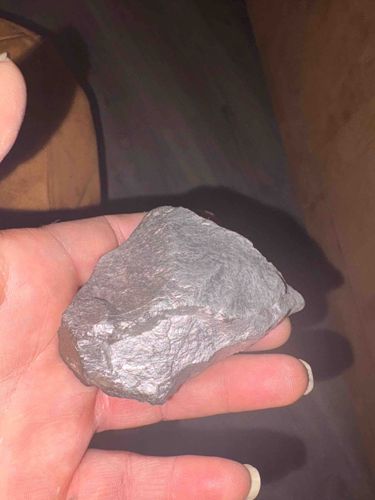
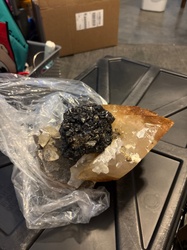
The item is an unpolished, irregularly shaped mineral specimen, held within the palm of a hand, suggesting it is a handheld size, likely several inches in its longest dimension. Its color is consistently a dull, matte metallic gray, lacking significant luster but showing some reflective qualities on its fractured surfaces. The surface is rough and uneven, characterized by numerous angular facets and natural cleavages, indicating a crystalline or granular internal structure that has been exposed through natural breakage or rudimentary extraction. There are no discernible markings, inscriptions, or polished areas that would suggest human modification or identification. The overall presentation is that of a raw piece of rock or ore. The condition appears to be natural, with no obvious signs of wear, damage, or repair beyond its intrinsic geological formation. The lack of polished facets or specific geometric shapes points toward a natural, unworked state. Its overall appearance is consistent with many metallic ores, such as galena, hematite, or even certain types of meteorite, though a definitive identification is impossible without further geological or chemical analysis. The visible texture varies from finely crystalline to more coarsely fractured areas. No specific manufacturing details or style period can be attributed as it appears to be a natural object. The quality is simply that of a natural, raw mineral sample.
AI Appraisal Report
Based on my visual examination of the provided image, this unpolished, irregularly shaped mineral specimen presents as a natural, unworked piece of metallic ore. Its matte metallic gray coloration, rough surface with angular facets, and fractured appearance are consistent with many common metallic minerals. I assess its condition as natural, with no signs of human modification, wear, or repair beyond its inherent geological formation.
Market conditions for such raw, unidentified mineral specimens are generally low. Without definitive identification through geological or chemical analysis, its value is primarily decorative or as a generic educational sample. Comparable items in this unverified state typically fetch prices in the range of a few to twenty dollars, often sold as 'mystery rocks' or basic mineral samples at rock shops or online.
Demand for an unconfirmed metallic mineral is minimal outside of specialist collectors actively seeking specific, identified species. Rarity cannot be determined without identification; it could be a common ore like hematite or galena, or a more unusual, but still widely available, metallic mineral. Factors significantly impacting value would be positive identification as a rare mineral, provenance indicating a significant find location, or confirmation as a meteorite. As it stands, these factors are absent.
It is crucial to note the limitations of authenticity and identification verification from images alone. While it appears genuinely natural, a definitive identification of the mineral type (e.g., galena, hematite, magnetite, or a meteorite fragment) is impossible without in-person examination, specific gravity testing, streak testing, hardness testing, and potentially X-ray diffraction or electron microprobe analysis. Without such scientific testing, the potential for its true value remains unconfirmed.