AI estimate as of November 4, 2025 · verify with a professional before acting
AI-Generated · Verify before acting
Everything on this page is generated by AI for informational purposes only. AI can make mistakes — the AI may misidentify items or misattribute them (artist, maker, brand, designer, origin, era). This is not an official valuation and should not be used for insurance, sale, tax, estate, legal, or lending purposes — or any decision requiring a certified appraisal. It is not an authoritative claim about any person, brand, or rights holder — do not share or rely on it as a factual statement about a third party. Always consult qualified professionals before making financial decisions.
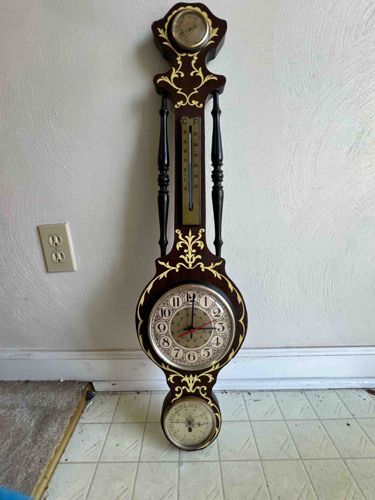
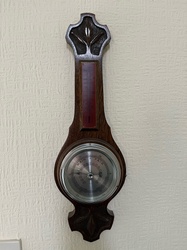
This is a Victorian-style combination wall instrument, likely from the early to mid-20th century, designed to display time, atmospheric pressure, and temperature. The piece features a dark stained wooden frame, possibly mahogany or a similar hardwood, with an elaborate, scrolling gold-painted or stenciled decoration running along its edges, typical of aesthetic movement or late Victorian design. The overall shape is elongated, with a decorative carved top, a central elongated section, and a rounded, bulbous base.
Physically, it stands tall, suggesting it was intended to be a prominent wall fixture. The construction appears to be machine-made with some hand-finishing for the decorative elements. The top section houses a barometer with a circular dial and an ornate brass bezel, showing some signs of age and possibly slight discoloration on the dial surface. Below this, integrated into the central spine, is a thermometer, set against a brass or gold-toned metal plate with Fahrenheit and Celsius scales clearly marked. The thermometer glass tube appears intact. Flanking the central thermometer are two turned pillars made of dark wood, contrasting with the main body and adding to its decorative appeal.
Another prominent feature is the large, central clock face, housed within a round opening in the wood frame. The clock features Arabic numerals, a gold-toned chapter ring, and a white or cream-colored dial with a patterned center. The hour and minute hands are black, while the second hand is red, providing a visual distinction. The bezel surrounding the clock face is also brass or gold-toned, complementing the other metallic accents. At the very bottom, a second barometer or possibly a hygrometer is located, again with a circular dial and matching brass-toned bezel.
The item shows signs of age consistent with its estimated period, including minor wear to the wood finish and perhaps some fading or tarnishing to the gold-painted details. The dials generally appear legible, although some slight patina or dust may be present under the bezels. There are no immediately apparent significant damages such as cracks in the wood or broken glass, but a closer inspection would be needed to confirm the condition of all internal mechanisms. The craftsmanship indicates a mass-produced item designed to emulate the opulence of earlier Victorian pieces, making it a decorative and functional accessory for a classically-styled interior.
AI Appraisal Report
Based on my visual examination of the provided image, this Victorian-style combination wall instrument, encompassing a clock, barometer, and thermometer, appears to be an early to mid-20th century decorative piece. The construction, with its dark stained wood and gold-painted ornamentation, is consistent with mass-produced items from that era designed to evoke Victorian opulence rather than being a high-end antique.
The condition appears fair, with visible wear to the wood finish and potential tarnishing or fading of the gold details and metallic bezels. The dials generally look legible, though some patination is evident. No significant damages like cracks or broken glass are immediately apparent. The craftsmanship suggests it's a decorative item rather than a precision scientific instrument.
Market conditions for such combination wall instruments are relatively stable but not subject to significant appreciation. Comparable items from the early to mid-20th century in similar condition typically sell in the low to mid-hundreds. Demand is modest, primarily from individuals seeking period-appropriate decorative accents. The item is not particularly rare; many similar pieces were produced.
Factors impacting value include its decorative appeal and functional combination of instruments. However, it's not a true antique by pre-1900 standards, and its mass-produced nature limits its top-tier value.
Limitations in authenticity verification from images alone are significant. I cannot verify the functionality of the clock movement, barometer, or thermometer. An in-person examination would be crucial to assess the internal mechanisms, determine the exact materials of the frame and dials, and confirm the absence of hidden repairs or significant structural issues. Provenance documentation, if available, could offer insights into its manufacturing origin and history, though for a decorative piece of this type, it's less critical unless it has a unique connection.