AI estimate as of November 29, 2025 · verify with a professional before acting
AI-Generated · Verify before acting
Everything on this page is generated by AI for informational purposes only. AI can make mistakes — the AI may misidentify items or misattribute them (artist, maker, brand, designer, origin, era). This is not an official valuation and should not be used for insurance, sale, tax, estate, legal, or lending purposes — or any decision requiring a certified appraisal. It is not an authoritative claim about any person, brand, or rights holder — do not share or rely on it as a factual statement about a third party. Always consult qualified professionals before making financial decisions.
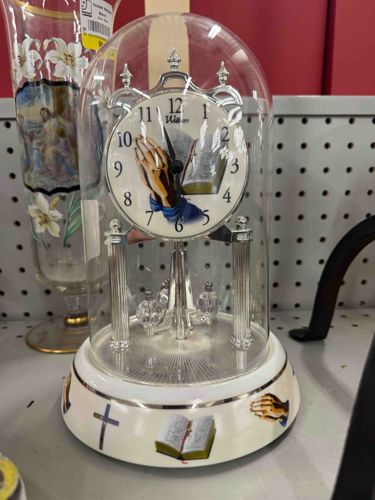
This item is a decorative mantle or table clock encased within a clear glass dome, featuring a strong religious theme. The clock exhibits a mechanical pendulum with four rotating crystal-like elements at its base, creating a kinetic display. The overall structure appears to be constructed from plastic components, likely silver-toned plastic for the structural elements within the dome and a white plastic base. The clock face itself is white with black Arabic numerals (1-12) and displays a central image of hands clasped in prayer, set against an open Bible. The brand name 'Wim' is visible above the '12' position. Silver-colored ornate finials adorn the top and sides of the clock frame, enhancing its decorative appeal. The base of the clock is a circular, off-white or cream-colored band, decorated with religious motifs including a cross, an open Bible, and praying hands, repeated around its circumference. A thin silver-colored line separates the main body of the base from its bottom edge. The item appears to be in good, used condition with no visible significant damage, cracks, or repairs, though minor surface wear consistent with age and previous use might be present. The clear glass dome is intact. The item reflects a 'kitsch' or decorative religious aesthetic, likely dating from the late 20th century to early 21st century. The craftsmanship is typical of mass-produced decorative items, characterized by molded plastic and printed decals.
AI Appraisal Report
Upon visual examination of the provided image, I assess this Religious Theme Dome Mantle Clock with Pendulum to be in good, used condition. There are no visible significant cracks, chips, or repairs to the plastic components or the clear glass dome. Minor surface wear consistent with its age and previous use is likely present but not discernible from the image. The authenticity appears to be as a mass-produced decorative item, likely from the late 20th to early 21st century, given the materials (molded plastic, printed decals, 'crystal-like' rotating elements) and 'kitsch' aesthetic. The brand 'Wim' is noted.
Market conditions for such decorative religious-themed items, particularly those of mass-produced plastic construction, generally reflect a low value. While the kinetic pendulum adds a unique visual element, it does not significantly elevate its collectible status. Comparables found in online marketplaces (e.g., eBay, Etsy for similar dome clocks or religious novelty items) typically range from $10 to $40. Demand for such specific, non-antique, mechanically simple religious decor is niche and not high, making it non-rare. The primary factors impacting its value are its decorative appeal to a specific demographic and its functional condition as a clock, which cannot be verified without physical inspection.
Limitations in authenticity verification from images alone are significant for mechanical items. I cannot verify if the clock mechanism is functioning correctly, if the pendulum rotates as intended, or if there are any battery compartment issues. A physical in-person examination would be needed to test functionality, inspect for hidden damage or repairs, and confirm the specific type of plastic and exact craftsmanship. Provenance documentation would be required for any claims of historical significance or a specific manufacturer batch. Scientific testing (e.g., material analysis) would be needed for definitive material identification if ambiguity existed, but for this item, visual assessment of plastic is sufficient for valuation.