AI estimate as of November 27, 2025 · verify with a professional before acting
AI-Generated · Verify before acting
Everything on this page is generated by AI for informational purposes only. AI can make mistakes — the AI may misidentify items or misattribute them (artist, maker, brand, designer, origin, era). This is not an official valuation and should not be used for insurance, sale, tax, estate, legal, or lending purposes — or any decision requiring a certified appraisal. It is not an authoritative claim about any person, brand, or rights holder — do not share or rely on it as a factual statement about a third party. Always consult qualified professionals before making financial decisions.
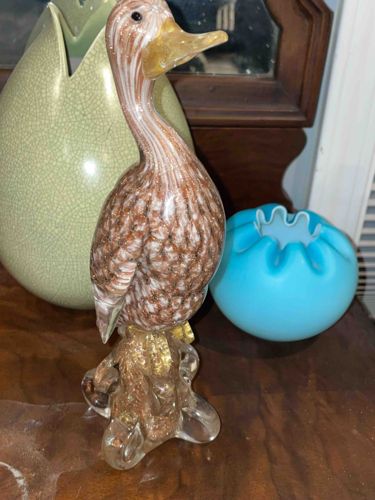
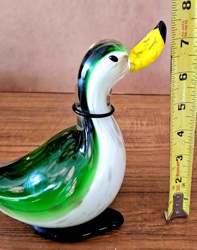
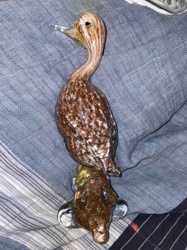
This is a captivating art glass figurine depicting a duck, likely crafted in the Murano style, given the materials and technique. The duck stands upright on a clear glass base, which appears to be a stylized representation of water or foliage, infused with shimmering gold aventurine. The body and neck of the duck are primarily a rich reddish-brown or copper color, variegated with streaks and flecks of white and clear glass, giving the impression of feathers. This 'latticino' or 'zanfirico' type of internal filigree work is characteristic of Venetian glassmaking. The head of the duck features a distinct yellow or amber-colored beak and small, dark glass eyes. The overall form is graceful, with an elongated neck slightly curved, suggesting an alert or observing posture. The glass has a smooth, glossy finish throughout. The inclusion of aventurine, particularly in the base and subtly within the body, indicates a higher level of craftsmanship and adds a sparkling effect. No obvious chips, cracks, or repairs are visible from the provided images, suggesting it is in good vintage condition. The complexity of the internal glasswork and the artistic rendering of the duck suggest it could be from the mid-20th century to late 20th century, a period known for a resurgence in Murano art glass production and animal figurines. The lack of a visible maker's mark prevents definitive attribution, but the style strongly aligns with Murano glass traditions.
AI Appraisal Report
I have examined the provided image of this art glass duck figurine. Visually, the piece appears to be in very good vintage condition, exhibiting no overt chips, cracks, or repairs. The smooth, glossy finish is intact, and the internal glasswork, including the 'latticino' style streaking and aventurine, presents beautifully. The design and technique strongly suggest a Murano or Murano-style origin, with the aventurine inclusion being a hallmark of quality Venetian glass. The 'zanfirico' approach evident in the body's coloration and the distinct amber beak are consistent with mid-to-late 20th-century art glass production.
From a market perspective, similar Murano-style animal figurines, especially ducks with aventurine or complex internal work, typically fetch prices in the lower to mid-hundreds. Demand for vintage Murano animalia remains steady, driven by collectors and enthusiasts of art glass. However, without a visible maker's mark or signature, definitive attribution to a specific Murano master or studio is impossible from images alone, which inherently limits its top-tier value compared to signed pieces. Rarity is moderate; while well-crafted, this specific design is not exceedingly rare.
Key factors impacting value are the excellent visual condition and the sophisticated glasswork. The primary limitation in authenticity verification from an image is the absence of a mark and the inability to physically inspect the weight, pontil mark, and precise glass characteristics. For full authentication and a more definitive appraisal, an in-person examination to assess the pontil mark, glass quality, and potential UV light testing for repairs would be essential. Furthermore, any provenance documentation, such as original sales receipts or certificates, would significantly enhance its value by confirming its origin. Based on visual assessment alone, I estimate the appraisal value to be between $150 and $250.