AI estimate as of October 10, 2025 · verify with a professional before acting
AI-Generated · Verify before acting
Everything on this page is generated by AI for informational purposes only. AI can make mistakes — the AI may misidentify items or misattribute them (artist, maker, brand, designer, origin, era). This is not an official valuation and should not be used for insurance, sale, tax, estate, legal, or lending purposes — or any decision requiring a certified appraisal. It is not an authoritative claim about any person, brand, or rights holder — do not share or rely on it as a factual statement about a third party. Always consult qualified professionals before making financial decisions.
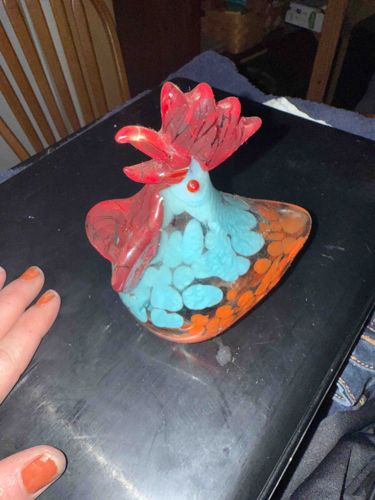
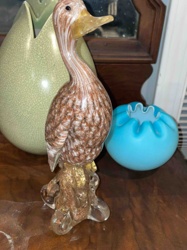
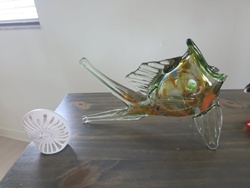
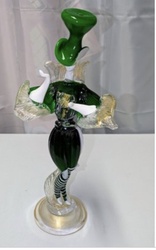
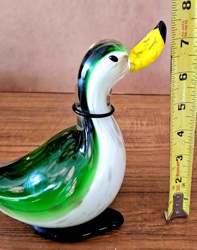
This item is a decorative rooster figurine, likely crafted from Art Glass, specifically reminiscent of Murano glass techniques. The figurine features a translucent body with encapsulated colored glass chips, forming a mosaic-like pattern. The predominant colors are a vibrant, translucent red for the comb, wattle, and tail feathers, a milky opalescent blue for the body's 'wing' sections, and a bright orange for the lower part of the body, potentially representing breast feathers or additional tail elements. Smaller, round red dots are embedded to denote the eyes. The construction appears to be solid glass, possibly hand-blown or formed, indicated by the organic, slightly irregular shapes of the embedded glass frit. The texture of the red comb and wattle seems to have some internal striations or relief, adding to its visual interest and suggesting a handcrafted finish rather than a smooth, molded surface. There are no visible maker's marks or signatures in the provided image. The style suggests a mid-20th century to contemporary art glass piece, often associated with Italian Murano glass studios known for their colorful and distinctive animal figures. The overall condition appears good, with no obvious chips, cracks, or significant damage, though some dust or surface residue is visible, particularly on the darker areas of the base, which is consistent with display or storage wear. The craftsmanship, evident in the controlled placement of the colored glass and the formation of the avian shape, suggests a skilled artisan.
AI Appraisal Report
I've carefully examined the provided image of this art glass rooster figurine. The overall condition appears quite good; I see no obvious chips, cracks, or significant damage that would detract from its display value. There's some minor surface dust, consistent with age and display, but this is easily remedied. The use of translucent red for the comb, wattle, and tail, milky opalescent blue for the body's 'wings,' and bright orange for the lower body, coupled with embedded colored glass chips, strongly suggests Murano or Murano-style art glass, likely from the mid-20th century onwards. The craftsmanship, particularly in the controlled placement of the frit and the charming form, points to a skilled artisan.
Authenticity is difficult to definitively confirm from images alone. While it exhibits characteristics typical of Murano glass – vibrant colors, inclusion of frit, and an expressive form – without a physical examination, I cannot confirm it was produced in Murano, Italy. A hands-on inspection would allow me to check for pontil marks, assess glass quality and weight, and look for any subtle manufacturing clues. Additionally, provenance documentation (such as original purchase receipts or artist signatures) would be invaluable for full authentication. Without such proofs, it's valued as 'Murano-style' art glass.
Market conditions for such decorative art glass roosters are generally steady. Comparables from reputable sellers for unsigned Murano-style figurines of similar size and quality typically range from $150 to $250. While charming, these figurines are not particularly rare, nor is there exceptionally high demand unless attributed to a renowned master. The lack of a visible maker's mark or signature significantly impacts its value, preventing it from reaching the higher price points associated with documented Murano masters.