These notes were written by the person who submitted this item. Appraiser.AI has not verified them, and the AI's identification and estimate may rely on them.
AI Estimated Value
Not an official valuation
$75 - $125
AI estimate as of October 3, 2025 · verify with a professional before acting
AI-Generated · Verify before acting
Everything on this page is generated by AI for informational purposes only. AI can make mistakes — the AI may misidentify items or misattribute them (artist, maker, brand, designer, origin, era). This is not an official valuation and should not be used for insurance, sale, tax, estate, legal, or lending purposes — or any decision requiring a certified appraisal. It is not an authoritative claim about any person, brand, or rights holder — do not share or rely on it as a factual statement about a third party. Always consult qualified professionals before making financial decisions.
This analysis also relies on unverified notes provided by the user, which may be incomplete or inaccurate and could affect the result.
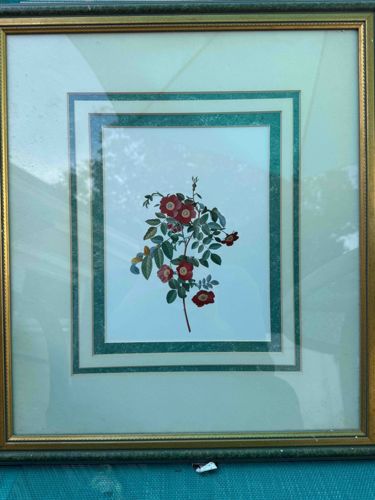
This item is a framed botanical print, likely a reproduction, depicting a cluster of red roses with green foliage. The artwork itself features a central arrangement of roses and their leaves, rendered in a delicate and detailed style typical of botanical illustrations. The roses exhibit variations in bloom, from tight buds to fully open flowers, showcasing rich red hues. The print is housed within a multi-layered framing system. An inner mat, directly surrounding the print, is a dark teal or emerald green with a subtle marbled or textured pattern. This is followed by a wider, lighter green mat, which also appears to have a slight texture or aged patina, likely an off-white or very pale green originally. The print and its mats are enclosed by a substantial picture frame. The frame itself is composed of two main sections: an inner gold-toned fillet with a slightly ornate, possibly beaded or reeded, edge, and an outer, wider frame molding finished in a darker, possibly antique gold or bronze color with a faint green undertone. The outermost frame has a somewhat distressed or aged appearance, contributing to a classical aesthetic. The overall condition is described as good; however, some light wear, dust, or very minor scuffs may be visible on the frame and matting, consistent with age and handling. The glass protecting the print appears clear, though reflections from the surrounding environment are visible.
AI Appraisal Report
Upon examining the provided image of the Framed Botanical Print of Red Roses, I assess the condition to be good, consistent with the owner's description. The print itself appears well-preserved under glass, showcasing vibrant red hues and delicate botanical detail. The multi-layered matting system, featuring a dark teal/emerald inner mat and a wider light green outer mat, complements the artwork effectively. The frame, with its inner gold fillet and wider antique gold/bronze outer molding, displays a classic aesthetic, though reflections indicate the presence of glass, making exact surface condition assessment challenging. I note the potential for minor surface wear, dust, or scuffs on the frame and matting, typical for an item of this nature and age. While the detailed style suggests a high-quality reproduction, definitive authenticity as an original antique botanical print cannot be confirmed solely from an image. I would need to physically examine the paper quality, printing technique (e.g., stipple, mezzotint marks under magnification), and any artist or publisher signatures to verify its originality or exact reproduction method. Market conditions for decorative botanical prints are generally stable for reproductions of this caliber. Comparable sales for similar framed decorative botanical prints, primarily reproductions, typically fall within the $75 to $150 range, depending on size, framing quality, and aesthetic appeal. Demand for well-framed botanical art remains consistent, particularly for classic floral subjects like roses. Rarity is not a significant factor here, as botanical prints, even antique ones, were often produced in editions. The primary impact on value is the decorative appeal and the quality of the framing. Without an in-person examination to verify the print's original status (e.g., hand-colored engraving vs. modern lithograph) and to assess the frame's true material and craftsmanship, its value is weighted towards being a high-quality decorative reproduction rather than a rare antique artwork. Provenance documentation could significantly increase value if it attests to an important artist or historical significance.