These notes were written by the person who submitted this item. Appraiser.AI has not verified them, and the AI's identification and estimate may rely on them.
AI Estimated Value
Not an official valuation
$100 - $200
AI estimate as of October 1, 2025 · verify with a professional before acting
AI-Generated · Verify before acting
Everything on this page is generated by AI for informational purposes only. AI can make mistakes — the AI may misidentify items or misattribute them (artist, maker, brand, designer, origin, era). This is not an official valuation and should not be used for insurance, sale, tax, estate, legal, or lending purposes — or any decision requiring a certified appraisal. It is not an authoritative claim about any person, brand, or rights holder — do not share or rely on it as a factual statement about a third party. Always consult qualified professionals before making financial decisions.
This analysis also relies on unverified notes provided by the user, which may be incomplete or inaccurate and could affect the result.
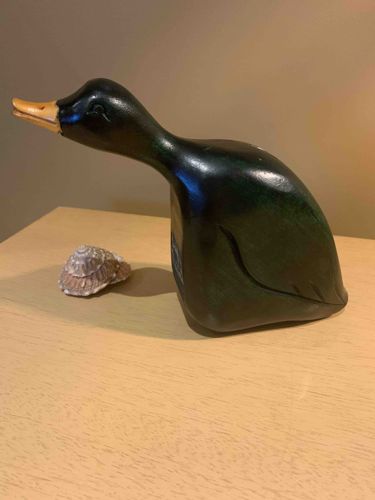
This item is a sculptural representation of a duck, likely carved from wood, exhibiting a stylized and somewhat abstract form. The primary color is a deep, iridescent dark green, possibly approaching black in certain lighting, which suggests a mallard drakecoloration. There are subtle variations in the green hue, suggesting hand-painting or a natural wood grain showing through a translucent stain. The head of the duck is slightly turned to the left, with an elongated neck that smoothly transitions into a simplified, block-like body. The beak is a contrasting light orange or yellow-ochre color, with a small black dot representing the nostril on each side. The eyes are indicated by small, recessed or carved indentations, also painted black, giving the duck a serene or observational expression. The surface appears to be glossy or semi-glossy, indicating a protective finish such as lacquer or varnish. There are no obvious visible markings such as maker's marks or signatures on the visible sides. The construction appears solid, carved from a single piece of wood or expertly joined. Some minor scuffs or dust specks might be present on the surface, consistent with display and handling, but no major cracks, chips, or repairs are immediately apparent. The craftsmanship suggests a folk art or decorative art piece, potentially a repurposed or decorative duck decoy, rather than a functional hunting decoy. Its smooth lines and simple form evoke a mid-20th-century aesthetic, but without specific markings, dating is approximate. The item rests on a light-colored wooden surface, beside what appears to be a small seashell, providing a sense of scale, though exact dimensions are not provided.
AI Appraisal Report
Upon examining the images provided of this carved wooden duck sculpture, attributed to Guy Tainier, I have formed my professional opinion of its value. The piece presents as a stylized, decorative mallard drake, likely carved from a single piece of wood. The deep green iridescent paint, ochre-colored bill, and simplified, modern form are characteristic of mid-20th-century decorative folk art. The overall condition appears to be very good, with a glossy finish and only minor surface scuffs consistent with display. There are no visible cracks, chips, or significant damage. The craftsmanship is competent and aesthetically pleasing. The value is primarily determined by its decorative appeal rather than its function as a collectible antique hunting decoy. The market for unsigned, decorative decoys of this style is generally stable. Comparable pieces by unknown or lesser-known 20th-century artists typically sell in the low to mid-hundreds at auction and in retail settings. While the name Guy Tainier is provided, they are not a widely documented or highly sought-after carver in established decoy collecting circles, which limits the potential for a premium valuation. The primary factor influencing value is its quality as a decorative object. A physical examination is necessary for a definitive assessment. This would allow me to inspect for a signature or maker's mark, analyze the wood type, paint composition, and construction techniques to confirm the age and rule out a modern reproduction. Without such an in-person inspection or supporting provenance documentation, full authentication cannot be guaranteed.