AI estimate as of June 25, 2025 · verify with a professional before acting
AI-Generated · Verify before acting
Everything on this page is generated by AI for informational purposes only. AI can make mistakes — the AI may misidentify items or misattribute them (artist, maker, brand, designer, origin, era). This is not an official valuation and should not be used for insurance, sale, tax, estate, legal, or lending purposes — or any decision requiring a certified appraisal. It is not an authoritative claim about any person, brand, or rights holder — do not share or rely on it as a factual statement about a third party. Always consult qualified professionals before making financial decisions.
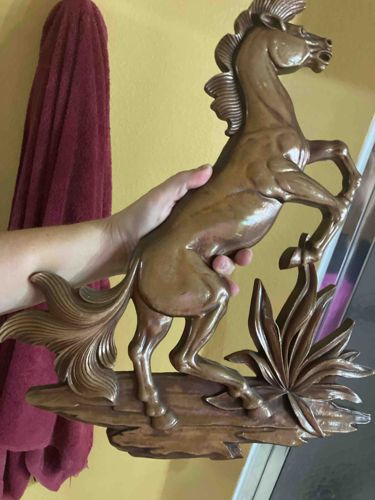
This item is a decorative wall plaque or freestanding sculpture depicting a rearing horse, likely crafted from a composite material such as resin, fiberglass, or a type of molded plastic, given its uniform color and glossy finish. The material appears to mimic the appearance of carved wood or bronze with a rich, warm brown color with subtle variations to create depth and highlight contours, suggesting a faux woodgrain or patinated bronze effect. The horse is depicted in a dynamic, rearing pose with its front hooves lifted high, its head turned slightly to the right with an open mouth and flared nostrils, conveying a sense of power and motion. The mane and tail are highly stylized and deeply textured, with individual strands flowing dramatically. The horse stands on a base that looks like a log or piece of natural wood, with additional foliage elements (possibly agave or palm-like leaves) carved into the right side of the base, further anchoring the scene. Its size is substantial, as indicated by the hand holding it, suggesting it could be around 18-24 inches in height. The craftsmanship appears to be commercially produced rather than individually handmade, evidenced by the consistent finish and probable mold lines (though none are clearly visible). There are no obvious signs of damage, cracks, or repairs, and the glossy finish appears intact. No maker's marks or signatures are discernible. This piece likely dates from the mid to late 20th century, possibly 1970s or 1980s, reflecting a popular decorative style of that era. Its quality is typical for mass-produced decorative art, offering a visually appealing piece without the inherent value of fine art materials like solid bronze or hand-carved wood.
AI Appraisal Report
I have examined the image of this Decorative Sculpture depicting a rearing horse. The item appears to be in excellent condition, with no visible damage, cracks, or repairs, and the glossy finish is intact. Authenticity, based on visual assessment, suggests this is a mass-produced item made from a composite material, likely resin or molded plastic, designed to mimic carved wood or patinated bronze. Its uniform color, glossy finish, and typical decorative style align with commercially produced items from the mid to late 20th century, probably the 1970s or 1980s. The craftsmanship is consistent with mass production rather than individual artistry.
Market conditions for such decorative sculptures are generally stable but do not command high prices. Comparables in online marketplaces (e.g., eBay, Etsy, local antique shops) for similar mass-produced rearing horse sculptures in good condition typically range from $40 to $120. Demand for these items is moderate, driven by collectors of equestrian decor or those seeking vintage decorative pieces. Rarity is low due to their mass-produced nature. Factors significantly impacting value include the material (composite vs. genuine bronze or hand-carved wood), the lack of a known artist or manufacturer, and its primarily decorative function.
It is important to note that a full authenticity verification would require in-person examination to confirm the material composition, search for any hidden maker's marks, and assess the true extent of its condition beyond what is visible in images. Provenance documentation, if available, could provide additional historical context but is unlikely to significantly impact the value of this type of item. Scientific testing, such as material analysis, would confirm the precise composition.