These notes were written by the person who submitted this item. Appraiser.AI has not verified them, and the AI's identification and estimate may rely on them.
AI Estimated Value
Not an official valuation
$75-125
AI estimate as of October 13, 2025 · verify with a professional before acting
AI-Generated · Verify before acting
Everything on this page is generated by AI for informational purposes only. AI can make mistakes — the AI may misidentify items or misattribute them (artist, maker, brand, designer, origin, era). This is not an official valuation and should not be used for insurance, sale, tax, estate, legal, or lending purposes — or any decision requiring a certified appraisal. It is not an authoritative claim about any person, brand, or rights holder — do not share or rely on it as a factual statement about a third party. Always consult qualified professionals before making financial decisions.
This analysis also relies on unverified notes provided by the user, which may be incomplete or inaccurate and could affect the result.
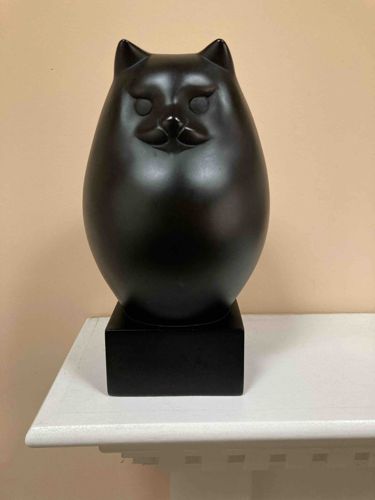
This is a stylized sculpture of a cat, likely a reproduction from the Boston Museum of Fine Arts. The item is characterized by its sleek, minimalist design, depicting a cat in an almost egg-shaped or ovoid form for the body, transitioning into a subtly modeled head. It is entirely black with a matte or satin finish, absorbing light rather than reflecting it, which enhances its sculptural qualities. The cat's face features rudimentary, depressed eye sockets, a small, subtle nose, and a delicately rendered mustache-like feature above the mouth area, providing just enough detail to evoke a feline presence without being overtly realistic. The ears are pointed upwards, typical of a cat, and are smoothly integrated into the overall head shape. The sculpture stands on a rectangular, solid black base, which appears to be integral to the piece rather than a separate component. The construction material is likely a resin, ceramic, or a composite material, chosen for its ability to hold fine detail and maintain a uniform matte finish. There are no visible signs of wear, damage, repairs, or significant patina, suggesting it is either well-maintained or a relatively recent reproduction. The craftsmanship appears high, with smooth surfaces, clean lines, and a consistent finish. The style is modern minimalist, possibly drawing inspiration from ancient Egyptian cat figures or Art Deco animal sculptures, reinterpreted for a contemporary aesthetic. No discernible maker's marks or signatures are visible in the provided images. The overall impression is one of elegant simplicity and artistic interpretation.
AI Appraisal Report
I have examined the image provided of this Black Stylized Cat Sculpture, identified as a Boston Museum of Fine Arts reproduction. Visually, the piece appears to be in excellent condition, showing no signs of wear, chips, cracks, or repairs. The finish is consistent and even, suggesting a high-quality reproduction. Its authenticity as a reproduction from the Boston Museum of Fine Arts relies solely on the owner's statement, as no maker's marks or provenance documentation are visible or provided. This type of decorative item typically falls under the category of museum gift shop merchandise.
Market conditions for museum reproductions, especially those lacking unique artist signatures or limited edition statuses, are generally stable but do not command high prices. They are appreciated for their aesthetic appeal and connection to a renowned institution, but their value is primarily decorative. I've considered comparable museum reproductions of similar size and material, which often retail new in the $50-$150 range. As a secondary market item, its value would likely be slightly lower than its original retail price unless it's a particularly sought-after or discontinued edition. Demand for such items is moderate among collectors of decorative arts and museum enthusiasts, but it is not rare.
Factors impacting value include its excellent condition and its association with a prestigious museum. However, its mass-produced nature as a reproduction limits its top-end value. For full authentication of its origin as a specific Boston Museum of Fine Arts reproduction, I would need to examine any original packaging, receipts, or internal markings that might confirm its provenance. A physical inspection would also allow for a definitive determination of material composition, which could subtly affect value, though it's likely resin or a similar composite. Without such documentation or physical examination, my assessment of its origin is based on good faith and visual evidence consistent with the description.