AI estimate as of November 2, 2025 · verify with a professional before acting
AI-Generated · Verify before acting
Everything on this page is generated by AI for informational purposes only. AI can make mistakes — the AI may misidentify items or misattribute them (artist, maker, brand, designer, origin, era). This is not an official valuation and should not be used for insurance, sale, tax, estate, legal, or lending purposes — or any decision requiring a certified appraisal. It is not an authoritative claim about any person, brand, or rights holder — do not share or rely on it as a factual statement about a third party. Always consult qualified professionals before making financial decisions.
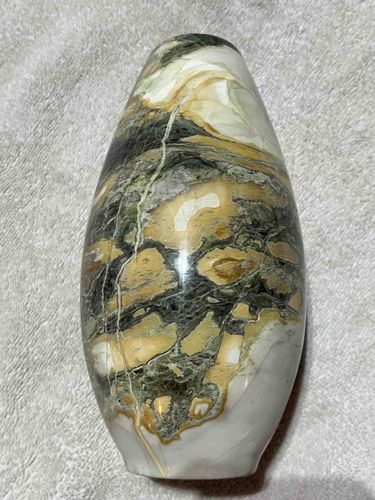
This item is a polished obelisk-form decoration crafted from a single piece of natural stone, likely a variety of serpentine or jasper, given its striking and varied coloration. The form is a smooth, elongated oval or ovoid shape, tapering gently towards a subtly rounded top and a flatter, stable base. The stone exhibits a complex and captivating natural pattern, primarily featuring large veins and inclusions of a creamy 'oatmeal' or light beige color, interspersed with rich, deep olive-green to charcoal gray sections. These darker areas often showcase intricate spiderweb-like fracturing patterns, filled with lighter mineral deposits, creating a mosaic or brecciated appearance. There are also hints of lighter white or very pale green visible, especially near the top and bottom edges, suggesting various mineral layers. The surface is highly polished, giving it a glossy sheen that accentuates the depth and natural variation of the stone. No visible manufacturing marks, signatures, or stamps are discernible from the provided images, suggesting it might be a contemporary decorative piece highlighting natural stone beauty, or an older piece without prominent markings. The condition appears excellent, with no obvious chips, cracks, or significant wear visible on the polished surface, which is a testament to both the material's durability and careful handling. The craftsmanship involves precise cutting and extensive polishing to achieve the smooth, elegant form and lustrous finish, indicative of quality lapidary work. Its abstract, organic aesthetic makes it suitable for modern or eclectic decor.
AI Appraisal Report
Upon examining the provided image of this polished natural stone obelisk-form decoration, I assess its condition as excellent. The polished surface appears free of chips, cracks, or significant abrasions, which indicates careful handling and quality finishing. Authenticity as a natural stone piece is supported by the varied and intricate veining, typical of serpentine or jasper, which cannot be artificially replicated with such natural complexity. The craftsmanship evident in its smooth form and high polish suggests competent lapidary work.
Market conditions for decorative natural stone objects are generally stable, with a consistent demand for unique, aesthetically pleasing pieces. Comparables typically include similar-sized obelisks, spheres, or freeform sculptures made from semi-precious or decorative stones like various jaspers, serpentines, or marbles. These often retail in the $100-$300 range, depending on the stone's rarity, the intricacy of its pattern, and the quality of the finish. This piece's striking coloration and complex 'spiderweb' patterns enhance its aesthetic appeal, contributing positively to its value.
While not exceptionally rare, the specific patterning of this stone makes it unique. Factors impacting value include the quality of the stone, the intricacy and appeal of its natural patterns, and the excellence of the polish. Its excellent condition and appealing aesthetics contribute to its marketability. The primary limitation to this appraisal is the reliance on images alone. To fully authenticate the specific stone type (e.g., serpentine vs. jasper) and verify the absence of any repairs or concealed flaws, an in-person examination would be required. Furthermore, provenance documentation could potentially add to its value, though it is not typically expected for contemporary decorative stone items of this type.