AI estimate as of August 26, 2026 · verify with a professional before acting
AI-Generated · Verify before acting
Everything on this page is generated by AI for informational purposes only. AI can make mistakes — the AI may misidentify items or misattribute them (artist, maker, brand, designer, origin, era). This is not an official valuation and should not be used for insurance, sale, tax, estate, legal, or lending purposes — or any decision requiring a certified appraisal. It is not an authoritative claim about any person, brand, or rights holder — do not share or rely on it as a factual statement about a third party. Always consult qualified professionals before making financial decisions.
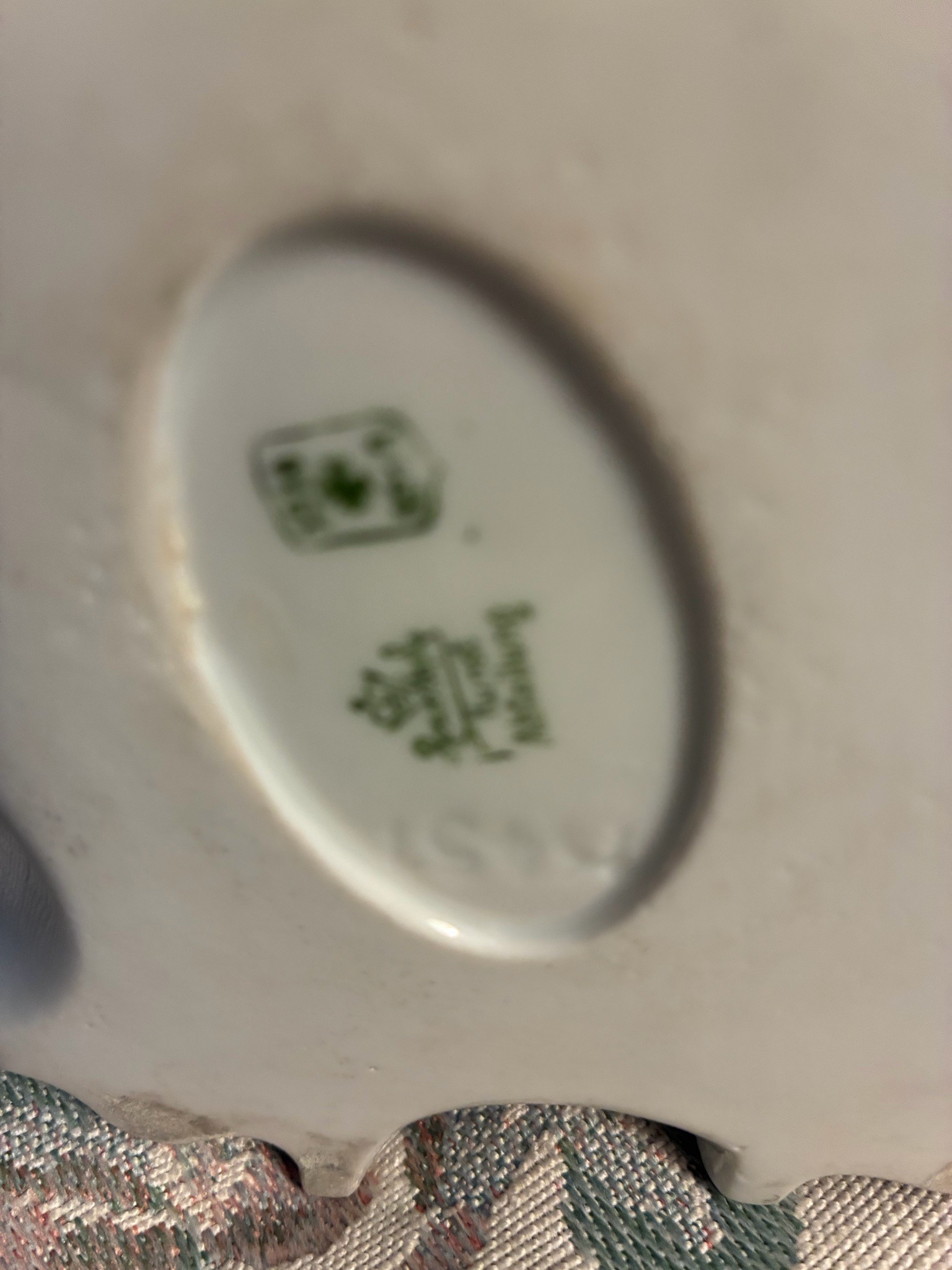
This physical item is a white glazed ceramic or porcelain object, photographed from an upward angle showing the recessed base of the piece. The body displays a smooth, glossy white surface with a scalloped or undulating edge visible along the bottom rim. On the concave base, there are distinct green underglaze markings along with an impressed numeric stamp. One green mark appears as a square containing a crest or shield-like graphic. Below or adjacent to this is a second green green printed mark featuring a crown motif and script text that is partially legible, consistent with historical marks used by the Hutschenreuther porcelain factory of Bavaria, Germany. Directly beneath these green stamps, an impressed number resembling '1514' is lightly pressed into the ceramic paste. The condition appears consistent with a vintage or antique display piece, showing slight surface grime around the recessed edges but no catastrophic structural fractures visible in this limited perspective. The identification of the maker rests entirely upon the green printed backstamps visible on the base, which share stylistic elements with known factory marks, though this piece remains unauthenticated and requires in-person examination by a specialist to determine its true era and production history. The overall aesthetic points toward mid-20th-century European decorative porcelain craftsmanship.
AI Appraisal Report
Based on what I can see in the provided image, this white glazed porcelain figurine features a smooth, glossy finish, a scalloped bottom rim, and a recessed base displaying green underglaze factory stamps alongside an impressed numeric stamp resembling '1514'. The green marks feature a crest and a crown motif, displaying visual similarities to historical backstamps associated with the Hutschenreuther porcelain factory of Bavaria, Germany. However, I cannot verify from a photo alone whether these marks are contemporary, reproduction, or period-correct, as visible markings can be forged or misread. The condition appears consistent with a vintage display piece, showing minor surface grime but no obvious structural fractures from this limited perspective. If the attribution to Hutschenreuther is correct, comparable mid-20th-century European decorative porcelain items of this type typically trade in the $150 to $350 range on the secondary art and antiques market, driven by steady demand for vintage German ceramics. To confirm the actual age, factory of origin, and overall authenticity, an in-person examination by a qualified ceramics specialist, hallmark verification, and detailed historical research would be needed. If physical inspection reveals the piece to be a later reproduction, replica, copy, or produced merely 'in the style of' the named manufacturer rather than a period piece, the market value would drop significantly, likely falling into the $30 to $75 range as a generic decorative object.