AI estimate as of November 4, 2025 · verify with a professional before acting
AI-Generated · Verify before acting
Everything on this page is generated by AI for informational purposes only. AI can make mistakes — the AI may misidentify items or misattribute them (artist, maker, brand, designer, origin, era). This is not an official valuation and should not be used for insurance, sale, tax, estate, legal, or lending purposes — or any decision requiring a certified appraisal. It is not an authoritative claim about any person, brand, or rights holder — do not share or rely on it as a factual statement about a third party. Always consult qualified professionals before making financial decisions.
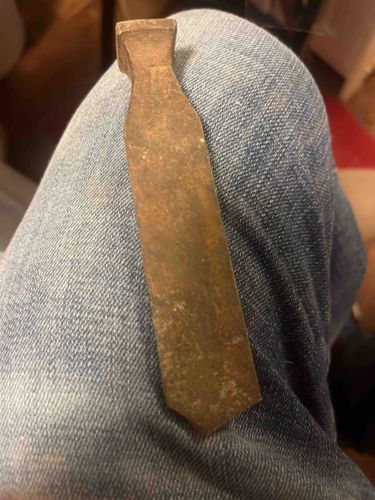
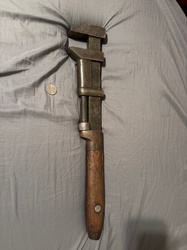
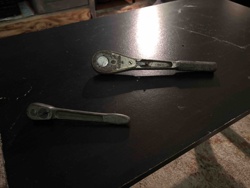
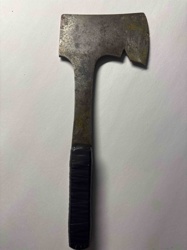
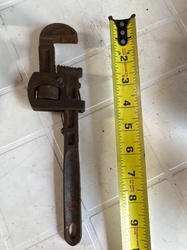
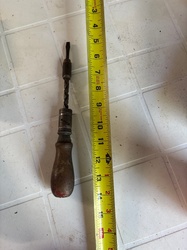
This item appears to be an antique or vintage hand tool, likely a flat chisel or a form of punch, crafted from iron or a similar ferrous metal. Its overall length is substantial, estimated to be around 6-8 inches, with a main body that is relatively flat and rectangular in cross-section. The color is a consistent reddish-brown, indicative of significant rust and patination accumulated over time, suggesting considerable age. The top portion, which presumably would be struck by a hammer, is squared off and shows signs of peening or mushrooming, a common characteristic in tools that have seen extensive use. Below the striking surface, the tool narrows slightly before flaring out into the main body, which maintains a uniform width and thickness for most of its length. The working end of the tool, though somewhat obscured by rust and the image angle, tapers to either a flat, sharp edge (suggesting a chisel) or a blunter, squared point (suggesting a punch). There are no discernible maker's marks, signatures, or stamps visible in the provided images, which is common for older, utilitarian hand tools. The heavy surface rust and pitting indicate prolonged exposure to moisture and lack of protective treatment, but the underlying structure appears intact without major fractures. The craftsmanship is robust and functional, consistent with tool-making practices of the late 19th or early to mid-20th century. Its rustic appearance and the heavy patina contribute to its vintage appeal as a collectible or decorative item.
AI Appraisal Report
Based on my visual examination of the provided image, this item is an authentic vintage iron flat chisel or punch. The reddish-brown color, heavy surface rust, and peening on the striking end are consistent with a utilitarian hand tool of significant age, likely late 19th to mid-20th century. The robust construction and lack of intricate detail align with typical period craftsmanship for such items.
The condition, while heavily patinated with rust and pitting, is expected for a cast-iron tool that has likely been stored without protection. Its underlying structure appears intact, which is a positive. However, the heavy rust obscures details that would aid in definitive identification beyond 'chisel or punch'.
Market conditions for common vintage hand tools of this nature are generally modest. While there is a steady demand from collectors of antique tools, DIY enthusiasts, or those seeking decorative rustic items, these are not exceedingly rare. Comparables on online marketplaces (e.g., eBay, Etsy) and at antique shows typically range from $10 to $40 for similar un-restored, un-marked iron chisels or punches.
Factors impacting value include the lack of any discernible maker's marks, which would significantly increase its worth if a prominent manufacturer were identified. Its general, unspecific nature also limits its appeal to highly specialized collectors. The primary value lies in its historical authenticity and rustic aesthetic.
It is important to note the limitations of authenticity verification from images alone. A physical examination would allow me to accurately determine the type of metal through scratch tests or magnetic properties, determine the exact state of the working edge (chisel vs. punch), and meticulously search for any faint, obscured maker's marks or stamps. Provenance documentation, though unlikely for such a common tool, would offer certainty regarding its age and origin. Scientific testing, such as elemental analysis, would confirm the metal composition without doubt.