AI Appraisal Estimate

AI-generated estimates · not official valuations

From the user

What was submitted

Photo and notes provided by the user — not generated by AI

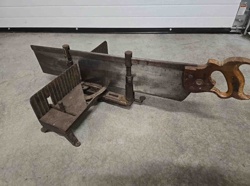
Submitted item photo
Submitted photo · June 10, 2026

User's notes

Antique hand drill

AI analysis below

AI appraisal

AI analysis & estimate

AI-Generated · Verify before acting

Everything below is generated by AI for informational purposes only. AI can make mistakes — the AI may misidentify items or misattribute them (artist, maker, brand, designer, origin, era). This is not an official valuation and should not be used for insurance, sale, tax, estate, legal, or lending purposes — or any decision requiring a certified appraisal. It is not an authoritative claim about any person, brand, or rights holder — do not share or rely on it as a factual statement about a third party. Always consult qualified professionals before making financial decisions.

Note

This analysis also relies on unverified notes provided by the user, which may be incomplete or inaccurate and could affect the result.

Read the full disclaimer

AI Identification

·Not independently authenticated·Verify before acting

Antique Hand Breast Drill with Wooden Handles

Antique Hand Tools

AI Estimated Value

·Not an official valuation·Verify before acting

$30-50

As of June 10, 2026

AI Item Analysis

·AI can make mistakes·Verify before acting
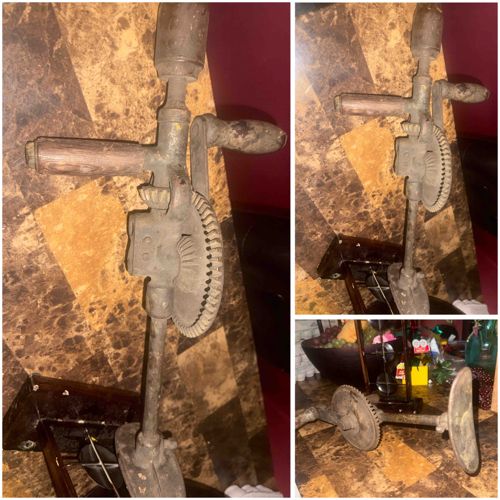
This item is an antique hand drill, commonly referred to as a "breast drill" due to the top handle designed to be pressed against the user's chest for leverage. It features a robust construction primarily of cast iron and steel, with two wooden handles. The main body of the drill displays a dark, aged patina consistent with its likely manufacturing period, suggesting brass or bronze components in some areas, or simply heavy oxidation on steel. The largest gear, prominently visible, has numerous teeth and shows signs of wear and accumulated grime in the recesses, but appears largely intact. A smaller pinion gear meshes with it, driving the central shaft. One wooden handle is positioned horizontally across the top, providing a grip for applying downward pressure. The other wooden handle extends perpendicularly from the gear mechanism, serving as the crank for rotation. Both wooden handles exhibit significant wear, discoloration, and some material loss, particularly on the cranking handle, indicating extensive use. There are no clearly discernible maker's marks or signatures visible in the provided images, which is common for older, utilitarian tools. The overall condition suggests a working tool that has seen considerable service and has not undergone significant restoration. The style and materials point to an estimated age likely from the late 19th to early 20th century. The craftsmanship, while utilitarian, reflects the durable and functional design characteristic of tools from this era.
AI Appraisal Report

·AI can make mistakes·Verify before acting
Upon examining the provided images of this antique hand breast drill, I assess it to be a utilitarian tool dating from the late 19th to early 20th century. My assessment of its condition is 'fair' to 'good' for its age and type. The cast iron and steel components exhibit a heavy, consistent patina and signs of extensive use, including accumulated grime and wear on the gear teeth. The wooden handles, particularly the crank, show significant wear, discoloration, and some material loss, which is consistent with a long working life and supports its authenticity as a period tool. The lack of any discernible maker's mark is a primary factor limiting its value; marked tools by well-known manufacturers like Millers Falls, Goodell-Pratt, or Stanley often command higher prices. The market for common, unmarked antique tools is primarily driven by decorators, collectors of rustic Americana, and woodworkers seeking serviceable vintage tools. Comparable unmarked breast drills in similar condition typically sell in the $30 to $50 range at flea markets, online auctions, and antique tool shops. Its value is as a decorative a historical artifact rather than a rare collectible. A significant increase in value would require the discovery of a rare maker's mark or a compelling history of ownership. While the images strongly suggest authenticity, a definitive verification is limited. A physical, in-person examination would be required to search for faint or hidden maker's marks, analyze the wood and metal more closely, and test the mechanical function, which are crucial for a complete and final appraisal.

Get your items appraised

Instant estimates of your treasures with AI-powered appraisals

Browse More Appraisals