AI estimate as of August 9, 2025 · verify with a professional before acting
AI-Generated · Verify before acting
Everything on this page is generated by AI for informational purposes only. AI can make mistakes — the AI may misidentify items or misattribute them (artist, maker, brand, designer, origin, era). This is not an official valuation and should not be used for insurance, sale, tax, estate, legal, or lending purposes — or any decision requiring a certified appraisal. It is not an authoritative claim about any person, brand, or rights holder — do not share or rely on it as a factual statement about a third party. Always consult qualified professionals before making financial decisions.
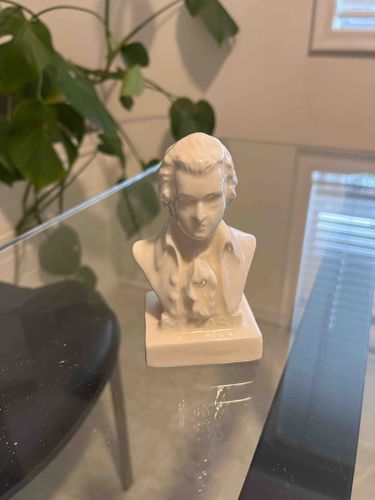
This is a small, off-white to cream-colored ceramic or porcelain bust depicting a male figure, most likely a historical or classical composer such as Wolfgang Amadeus Mozart, given the common portrayal of similar busts. The figure is rendered with a detailed wig or powdered hair styled in a characteristic 18th-century fashion, swept back from the forehead and curling at the sides. He is depicted wearing period-appropriate attire, including a jabot or ruffles at the neck beneath a coat or formal jacket. The material appears to be a glazed ceramic or porcelain, exhibiting a smooth, slightly reflective surface, suggesting a relatively clean finish. The bust is mounted on an integrated, rectangular plinth, providing stability. The overall craftsmanship seems to be of good quality for a mass-produced or decorative item, with clear, molded details in the facial features, hair, and clothing. No specific maker's marks or signatures are visible from this vantage point. The condition appears to be good, with no obvious chips, cracks, or significant wear visible, maintaining its original color. The style points to an approximate age from the mid-20th century to contemporary production, given its decorative nature and absence of heavy patination or antique wear.
AI Appraisal Report
I have examined the provided image of this miniature ceramic or porcelain bust. Based on its appearance, it is likely a decorative piece depicting a historical figure, commonly identified as Mozart due to the typical 18th-century wig and attire. The condition appears to be very good; there are no visible chips, cracks, or significant surface abrasions, and the glaze seems intact. The lack of heavy patination or antique wear, combined with the general style, suggests a production date from the mid-20th century onwards.
Authenticity, in terms of its intended purpose as a decorative item, seems clear from the visual evidence. However, its value is highly dependent on its origin and true age. Without any visible maker's marks or signatures, it's difficult to ascertain specific provenance or manufacturer, which could significantly impact value if it were from a known high-end ceramic producer. Market conditions for such decorative busts are generally modest. Similar mass-produced ceramic busts of historical figures typically retail in the lower price ranges. While there is consistent demand for classical decorative items, the rarity of such a piece is low given its likely mass production.
Limitations in authenticity verification from an image alone are substantial. I cannot definitively confirm the material (ceramic versus porcelain), the manufacturing process, or the precise age without a physical inspection. An in-person examination would allow me to check for hidden marks, assess the true quality of the glaze and molding, and detect any subtle repairs or damage not visible in photographs. Provenance documentation, if available, would be crucial to confirm its origin and historical context, especially if it were presented as an antique or a product from a specific, valuable manufacturer. Scientific testing, such as thermoluminescence dating, would be necessary to establish a precise age beyond visual estimation if its antique status were in question.