AI estimate as of July 31, 2025 · verify with a professional before acting
AI-Generated · Verify before acting
Everything on this page is generated by AI for informational purposes only. AI can make mistakes — the AI may misidentify items or misattribute them (artist, maker, brand, designer, origin, era). This is not an official valuation and should not be used for insurance, sale, tax, estate, legal, or lending purposes — or any decision requiring a certified appraisal. It is not an authoritative claim about any person, brand, or rights holder — do not share or rely on it as a factual statement about a third party. Always consult qualified professionals before making financial decisions.
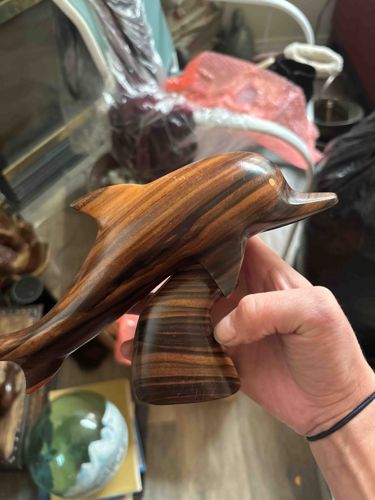
The item is a carved wooden sculpture depicting a dolphin leaping from a wave. It is crafted from a type of hardwood, likely a rosewood or similar exotic wood, characterized by its striking variegated grain patterns. The coloration consists of rich reddish-brown to dark chocolate-brown stripes, creating a natural, visually appealing contrast. The sculpture exhibits a smooth, polished finish, suggesting careful sanding and a protective coating, possibly lacquer or oil, which enhances the wood's inherent luster. The dolphin figure is anatomically rendered, with a streamlined body, dorsal fin, pectoral fins, and a tail fluke. A notable distinguishing feature is a small, light-colored inlay, possibly bone, shell, or a different wood, used to represent the dolphin's eye, adding a touch of lifelike detail. The base, integral to the sculpture, is shaped to resemble an abstract wave or water splash, providing stable support. The craftsmanship appears to be of good quality, with precise carving and a well-executed finish, indicating skilled handiwork. There are no obvious signs of significant damage such as cracks, chips, or repairs visible in the provided image. Small minor surface scratches or wear commensurate with age and handling might be present but are not clearly discernible. Given the style and material, it likely dates from the late 20th century to early 21st century, possibly originating from regions known for their wood carving traditions, such as Southeast Asia or Central/South America. There are no visible maker's marks or signatures on the accessible surfaces.
AI Appraisal Report
Upon visual examination of this Carved Wooden Dolphin Sculpture, I assess it to be a piece of good quality decorative art, likely from the late 20th or early 21st century. The material appears to be a type of exotic hardwood, possibly rosewood, prized for its dramatic grain. The craftsmanship is skilled, showing competent carving in the anatomical representation of the dolphin and the fluid form of the wave base. The smooth, polished finish and the small inlay for the eye are indicative of a carefully completed work. Based on the image, the condition is very good, with no major chips, cracks, or repairs visible. The primary market for this type of sculpture is decorative rather than fine art. Similar unsigned, hand-carved wooden animal sculptures are common, often originating from regions like Indonesia or the Philippines. Their value is driven by craftsmanship, material, and aesthetic appeal. Given the lack of a known artist or studio signature, the value is tied to its decorative merit. The market for such pieces is stable but modest. The variegated hardwood is a significant positive value factor. However, without physical inspection, I cannot definitively identify the wood species, confirm the material of the eye inlay (bone, shell, etc.), or uncover any hidden maker's marks or repairs. Full authentication would require in-person examination to assess the wood's density and scent, microscopic analysis of tooling marks, and a search for any concealed signatures.