AI estimate as of November 12, 2025 · verify with a professional before acting
AI-Generated · Verify before acting
Everything on this page is generated by AI for informational purposes only. AI can make mistakes — the AI may misidentify items or misattribute them (artist, maker, brand, designer, origin, era). This is not an official valuation and should not be used for insurance, sale, tax, estate, legal, or lending purposes — or any decision requiring a certified appraisal. It is not an authoritative claim about any person, brand, or rights holder — do not share or rely on it as a factual statement about a third party. Always consult qualified professionals before making financial decisions.
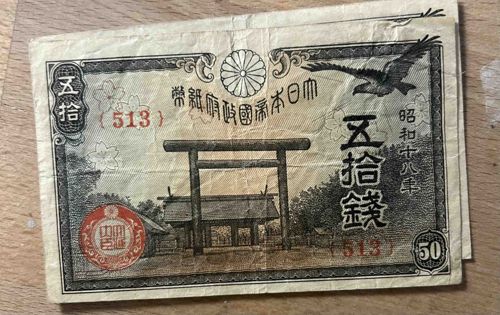
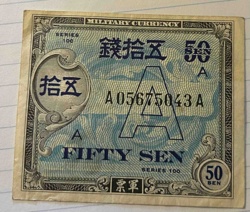
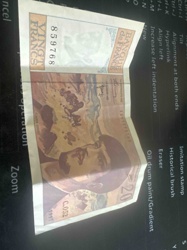
This item is a Japanese 50 Sen military scrip, likely from Series A, used during World War II. The banknote features a beige or off-white paper base, with printing primarily in black, grey, and red. The overall condition shows significant wear, with multiple creases and folds across the entire surface, suggesting it was circulated extensively. There is also a slight discoloration or darkening of the paper, consistent with age and handling.
The front of the note depicts a torii gate, a traditional Japanese gate most commonly found at the entrance to a Shinto shrine, in the center. Above the torii gate is the Imperial Seal of Japan, a stylized chrysanthemum. To the right of the torii gate, a large bird (possibly an eagle or hawk) is depicted in flight. Cherry blossoms (sakura) are visible as decorative elements throughout the design. Significant Japanese characters are present, with '五十銭' (50 Sen) prominently displayed in the center right. The serial number '513' is visible in red in two places, once on the left and once below the '50 Sen' text, indicating a specific issuance. The numeral '50' is also present in a circular emblem on the bottom right. A red circular stamp, likely a seal of authentication or issue, is visible on the bottom left. The text '昭和十八年' (Showa 18th Year) is discernible on the right, which corresponds to the year 1943. This scrip was part of the Japanese Military Yen series, issued for use in occupied territories or by military personnel during the war, and was not legal tender in Japan itself.
AI Appraisal Report
I have examined the provided image of the Japanese 50 Sen Military Scrip (Series A). This banknote is consistent with known examples of Japanese military yen issued during World War II, specifically from the Showa 18th Year (1943). The design elements, including the torii gate, chrysanthemum seal, bird in flight, cherry blossoms, denominational text '五十銭', and the serial number '513', all appear authentic for this type. The red circular stamp on the bottom left also aligns with typical markings.
Regarding its condition, this note shows significant wear. Multiple creases, folds, and general discoloration, consistent with extensive circulation and age, are evident. This places the note in a circulated grade, likely Fine (F) to Very Fine (VF).
In terms of market conditions, Japanese military scrip, while historically significant, is generally common for many denominations, especially those issued in large quantities. The 50 Sen note is not considered rare. Demand is primarily from collectors specializing in World War II memorabilia or Japanese currency. Comparables for notes in similar circulated condition typically fetch values in the low to mid-range. Factors significantly impacting value are primarily the condition and, to a lesser extent, specific serial number characteristics (though '513' does not indicate a special variety here).
Based on my visual examination, I assess the authenticity as highly probable. However, it is crucial to state that a definitive authentication requires a physical inspection. Without hands-on access, I cannot verify paper type, watermark (if any), printing methods, or detect any potential repairs or alterations that might not be visible in an image. An in-person inspection would allow for examination under magnification and potentially UV light, which could reveal details about the paper, ink, and any hidden security features or damage. Provenance documentation, while helpful for any collectible, is not typically a primary driver for military scrip of this commonality and value range.