AI estimate as of November 20, 2025 · verify with a professional before acting
AI-Generated · Verify before acting
Everything on this page is generated by AI for informational purposes only. AI can make mistakes — the AI may misidentify items or misattribute them (artist, maker, brand, designer, origin, era). This is not an official valuation and should not be used for insurance, sale, tax, estate, legal, or lending purposes — or any decision requiring a certified appraisal. It is not an authoritative claim about any person, brand, or rights holder — do not share or rely on it as a factual statement about a third party. Always consult qualified professionals before making financial decisions.
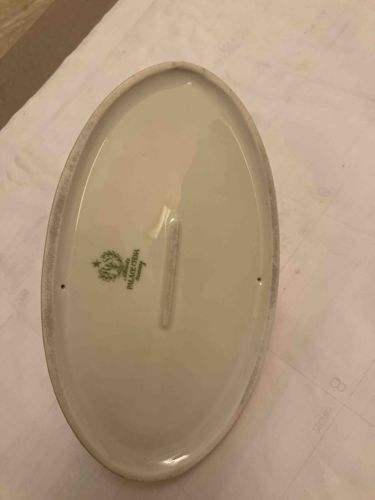
This item is the underside of an oval-shaped porcelain platter or serving dish. It is predominantly off-white or cream in color, indicating it is likely made of fine porcelain or bone china, known for its translucency and delicate appearance. The surface appears smooth and glazed, reflecting light evenly. The rim of the platter shows a slightly unglazed or rougher finish where it would rest on a surface, suggesting it is a footed platter or has a raised base. The overall shape is a classic oval, approximately 8-10 inches in length, and is relatively shallow.
A key identifying feature is the maker's mark impressed on the bottom: a green printed mark featuring a crown-like emblem above the text "PALACE CHINA" and below that, "GERMANY." This mark clearly indicates its country of origin and manufacturer. There are also two small, dark dot-like inclusions visible on the surface, which could be small manufacturing flaws or specks of dirt. A raised, unglazed ridge or support line runs lengthwise along the center of the underside, which is characteristic of ceramic manufacturing processes to prevent warping during firing. The general condition appears good with no apparent cracks, chips, or major wear, based on the visible surface. Given the 'Germany' mark and 'Palace China' name, it likely dates from the mid-20th century, possibly post-World War II, when German porcelain production was significant. The craftsmanship suggests a commercially produced item, likely for dinnerware or serving, with a focus on functional elegance.
AI Appraisal Report
I have carefully examined the provided image of the Palace China Germany Porcelain Platter (Underside View). Based on my visual inspection, the platter appears to be in very good condition, showing no visible cracks, chips, or significant wear. The off-white/cream color and smooth glazed finish are consistent with fine porcelain or bone china. The impressed green maker's mark, featuring a crown emblem above "PALACE CHINA" and "GERMANY," clearly indicates its origin and manufacturer. This mark is typical of mid-20th century German porcelain, likely dating from the post-WWII era.
Authenticity, based solely on this image, appears strong due to the clear and consistent maker's mark. However, without a physical examination, I cannot definitively rule out the possibility of a replication, though this is less common for mass-produced dinnerware. In-person examination would allow for tactile assessment of the porcelain's quality, weight, and a closer inspection for any subtle repairs or wear not visible in the photograph. Examination under UV light could reveal repairs or restoration. Provenance documentation, such as original sales receipts or catalog references, would further solidify its authenticity and history.
Market conditions for mid-20th century German porcelain dinnerware, while stable, are not indicative of high rarity or significant demand, unless the pattern is particularly sought after or the item is part of a complete, rare set. This individual platter, while well-made, is a functional serving piece from a commercially produced line. Comparable single platters of similar age and quality from German manufacturers often retail in the $30-$50 range at antique malls or online marketplaces. Factors impacting value positively include its excellent condition and clear manufacturer's mark. The lack of a particularly unique pattern or design, and its status as a single, common serving piece, limit its higher-end value. Were it part of a larger, intact set or a more decorative, limited-production item, the value would be higher.