AI estimate as of August 10, 2025 · verify with a professional before acting
AI-Generated · Verify before acting
Everything on this page is generated by AI for informational purposes only. AI can make mistakes — the AI may misidentify items or misattribute them (artist, maker, brand, designer, origin, era). This is not an official valuation and should not be used for insurance, sale, tax, estate, legal, or lending purposes — or any decision requiring a certified appraisal. It is not an authoritative claim about any person, brand, or rights holder — do not share or rely on it as a factual statement about a third party. Always consult qualified professionals before making financial decisions.
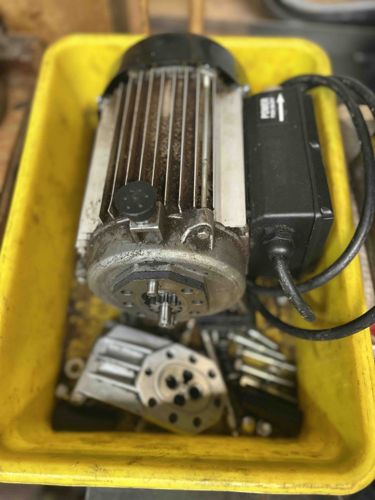
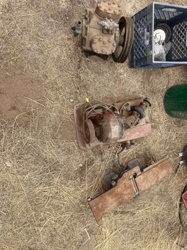
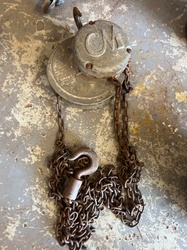
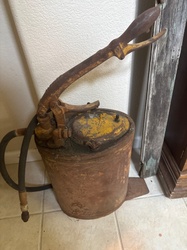
The item appears to be an industrial electric motor, possibly an AC motor given its finned housing, consistent with design for heat dissipation. It is primarily constructed from metal, likely aluminum or an aluminum alloy for the main body and fins, with black plastic or painted metal components for the terminal box and end cap. The motor features prominent vertical cooling fins along its cylindrical body, indicating it's designed to dissipate a significant amount of heat during operation. The overall color scheme is metallic gray for the body and black for associated components. At one end, a small exposed gear or spline shaft is visible, suggesting it's designed to connect to another mechanical component, possibly a pump or transmission. Below the main motor unit, another metal component, which appears to be a separate housing or part of a pump assembly, is present, displaying multiple bolt holes and a central opening, implying a direct coupling. The motor shows signs of significant use and wear, including dirt and grime accumulated between the cooling fins and on the housing surfaces. There might be some minor surface corrosion or pitting consistent with an industrial environment. The terminal box has a white arrow graphic pointing upwards along with some unreadable text, implying directional operation or installation guidelines. The manufacturing details, such as a maker's mark or specific model number, are not discernible from the image. Its robust construction and visible wear suggest it is a utilitarian piece of industrial machinery, likely from the late 20th to early 21st century, designed for reliability and heavy-duty applications. The craftsmanship appears to be functional and industrial-grade, prioritizing durability over aesthetic finish.
AI Appraisal Report
Based on my visual examination of the provided image, this industrial electric motor with an integrated gear/shaft appears to be a robust, utilitarian piece of equipment. Its finned housing suggests it's designed for significant heat dissipation, common in AC motors used in continuous or heavy-duty industrial applications. The overall construction is metal, likely an aluminum alloy for the main body due to its finned structure. The black components, likely made of plastic or painted metal, comprise the terminal box and end cap. The presence of cooling fins and the robust build indicate engineered durability rather than aesthetic appeal. The visible gear/spline shaft signifies it's designed for direct connection to another mechanical component, such as a pump, transmission, or similar machinery, as further suggested by the adjacent metal component with bolt holes.
I note significant signs of wear and use, including dirt and grime accumulation, particularly between the cooling fins. While there's no visible catastrophic damage, surface wear is consistent with an operational industrial environment. The white arrow graphic on the terminal box, along with unreadable text, implies specific installation or directional use. Due to the lack of discernible manufacturer markings, model numbers, or serial numbers, definitive authentication of its origin, exact model, or manufacturing date is impossible from images alone. This also limits precise comparisons to specific models.
Market conditions for used industrial motors are generally stable, driven by the need for reliable equipment in manufacturing and processing plants. Value is heavily dictated by known brand, precise specifications (HP, RPM, voltage, phase), and verified working condition. Without this information, the motor is valued as a general-purpose, used industrial component. Comparable items in unknown working condition typically sell for a fraction of new equivalent pricing. Demand for such components often stems from industries requiring replacement parts or setting up budget-conscious operations. Rarity is not a factor here; motors of this type are common.
Factors significantly impacting value include: the motor's specific power rating (HP/kW), rated RPM, voltage, phase, operating hours, and most critically, its verified operational status. A non-functional motor or one with internal electrical issues would have scrap value only. If this motor were from a well-known brand (e.g., Siemens, ABB, Baldor) and its specifications were known and confirmed to be in good working order, its value would significantly increase.
Limitations of authenticity verification are substantial from images alone. I cannot definitively ascertain the manufacturer, model, precise specifications, internal wear, or full operational status. For a full authentication and accurate appraisal, an in-person examination by a qualified technician is essential to test electrical continuity, winding integrity, bearing condition, and overall operational parameters. Provenance documentation (maintenance records, original purchase invoices) would also provide critical information regarding its history and authenticity.