AI estimate as of November 19, 2025 · verify with a professional before acting
AI-Generated · Verify before acting
Everything on this page is generated by AI for informational purposes only. AI can make mistakes — the AI may misidentify items or misattribute them (artist, maker, brand, designer, origin, era). This is not an official valuation and should not be used for insurance, sale, tax, estate, legal, or lending purposes — or any decision requiring a certified appraisal. It is not an authoritative claim about any person, brand, or rights holder — do not share or rely on it as a factual statement about a third party. Always consult qualified professionals before making financial decisions.
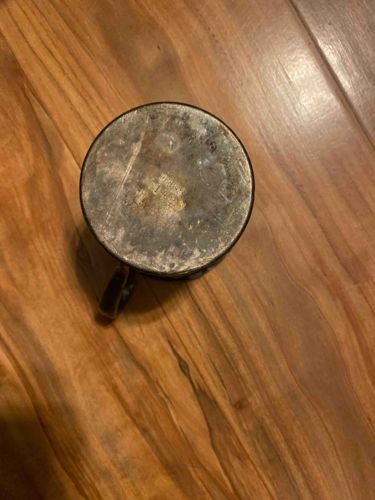
This item is identified as the bottom of a metal mug, heavily tarnished or intentionally antiqued, resting on a polished wooden surface. The circular base of the mug is clearly visible, exhibiting a significant amount of dark grey and greenish-brown discoloration, indicative of oxidation and age. The surface texture appears somewhat mottled and uneven, suggesting either a rough casting, significant wear, or a deliberate aged finish. There are no discernible maker's marks, stamps, or signatures visible on the bottom surface due to the heavy patina and the resolution of the image. The material appears to be a base metal, possibly pewter, brass, or copper, given the color of the oxidation, though silver plate cannot be entirely ruled out without further inspection. A small portion of a dark-colored handle is barely visible extending from the side of the mug, suggesting a traditional mug or tankard form. The overall condition suggests a vintage or antique piece that has not been recently polished, or it is designed to mimic such an aesthetic. The craftsmanship cannot be fully assessed from this view alone, but the visible wear and aging contribute to its character. The estimated age is difficult to pinpoint without more visual information, but the tarnish could signify an object from the early to mid-20th century or older if it's a true antique.
AI Appraisal Report
I have examined the image provided, which depicts the bottom view of a metal mug, heavily tarnished or antiqued, resting on a polished wooden surface. The circular base shows significant dark grey and greenish-brown discoloration, indicative of oxidation. The mottled surface suggests either rough casting, significant wear, or an intentional aged finish. Without visible maker's marks, stamps, or signatures due to the patina and image resolution, definitive identification of the metal is challenging, though it appears to be a base metal like pewter, brass, or copper. A silver plate cannot be entirely ruled out. A small portion of a dark handle is visible, confirming a mug or tankard form. The overall condition points to a vintage or antique piece, or a modern reproduction designed to look old. The craftsmanship cannot be fully assessed from this single view.
My assessment of condition indicates significant surface degradation, whether natural or artificially induced. Authenticity as a true antique is difficult to verify solely from this image. The lack of clear identifying marks is a major limitation. Market conditions for unmarked, heavily tarnished metal mugs are generally modest. Comparable items, often sold as decorative or rustic pieces, typically fetch low prices. Demand for such items is moderate; they appeal to those interested in vintage decor or collectors of specific metalware, but without provenance or distinct features, they are not highly coveted.
Factors significantly impacting value include the lack of maker's marks, the heavily tarnished (or artificially aged) surface, and the inability to definitively identify the base metal. Without physical inspection, I cannot confirm if the tarnish is natural aging or a manufactured 'antiqued' finish. For full authentication and to ascertain true value, an in-person examination would be critical to test the metal composition, feel the weight and quality of the construction, and search for obscured marks. Establishing provenance or comparing it to known examples of specific manufacturers would also be essential. Scientific testing (e.g., XRF analysis) could definitively identify the metal. Based on the visual information alone, I assess its value as an interesting decorative item rather than a collectible piece of significant monetary worth.