AI estimate as of October 11, 2025 · verify with a professional before acting
AI-Generated · Verify before acting
Everything on this page is generated by AI for informational purposes only. AI can make mistakes — the AI may misidentify items or misattribute them (artist, maker, brand, designer, origin, era). This is not an official valuation and should not be used for insurance, sale, tax, estate, legal, or lending purposes — or any decision requiring a certified appraisal. It is not an authoritative claim about any person, brand, or rights holder — do not share or rely on it as a factual statement about a third party. Always consult qualified professionals before making financial decisions.
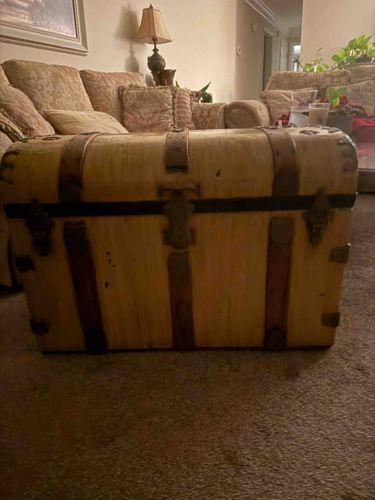
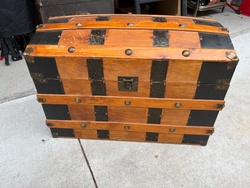
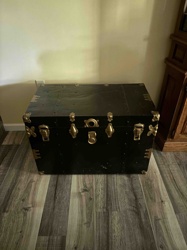
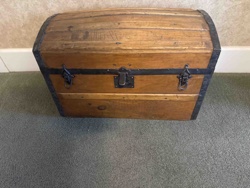
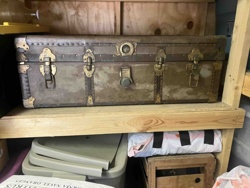
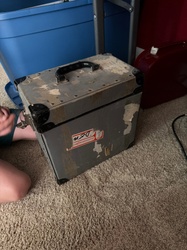
This is an antique steamer trunk, characterized by its rectangular form and domed or barrel-top lid, suggesting a style from the late 19th to early 20th century. The trunk features a light-colored, possibly painted or covered wooden body, appearing to be a cream or very pale yellow hue. It is reinforced with several dark, likely leather or metal, straps running both horizontally and vertically across its surface. The top of the trunk is also adorned with darker, possibly metal, banding or trim, secured with numerous small rivets or tacks, indicative of robust construction designed for travel. Hardware, including clasps on the front and possibly hinges on the sides, is dark-toned and appears to be made of aged metal, showing some signs of wear and patina consistent with age and use. The central latch mechanism on the front is quite prominent. The overall condition suggests significant age, with surface wear, scuffs, and possibly some discoloration visible on the lighter body material. The straps may also exhibit cracking or drying. There are no clear maker's marks visible in the provided image. The craftsmanship points to a utilitarian object built for durability during long journeys, typical of luggage from its era. This trunk would have been used for storing and transporting clothing and personal belongings.
AI Appraisal Report
Upon visual examination of this antique steamer trunk, I observe a classic late 19th to early 20th-century design, characterized by its domed or barrel-top lid and rectangular form. The light-colored, possibly painted wood body, reinforced with dark straps and metal banding secured by rivets, speaks to its original utilitarian purpose for travel. The aged metal hardware, including prominent clasps, shows a consistent patina and wear indicative of its age and use. The overall condition suggests significant age, with surface wear, scuffs, and potential discoloration on the body. While the straps appear intact, a physical inspection would be crucial to assess for cracking or drying. Its craftsmanship is typical of durable travel luggage from its era.
Market conditions for such steamer trunks are generally stable, driven by demand from interior decorators and collectors seeking pieces for storage or as decorative accents. This piece is not exceedingly rare; however, its domed top adds a degree of desirability over flat-top models. Factors significantly impacting value include its condition (presence of original interior, structural integrity), provenance (though none is visible), and the manufacturer (no clear maker's marks are discernible from the image). Without these, it's valued primarily as a decorative antique rather than a rare collector's item.
My primary limitation in full authenticity verification is the lack of physical inspection. An in-person examination would allow me to confirm the materials (wood type, metal composition, strap material), assess the structural integrity, check for hidden damages or repairs, and confirm the originality of all components. I would also look for any faint maker's marks or labels that might be obscured in the image. Provenance documentation would provide historical context and ownership lineage, which can significantly influence value. For now, based solely on visual evidence, I estimate its value to be in the range of $250-450, reflecting its decorative appeal and age, balanced against its visible wear and lack of definitive provenance or maker's marks.