AI estimate as of July 15, 2025 · verify with a professional before acting
AI-Generated · Verify before acting
Everything on this page is generated by AI for informational purposes only. AI can make mistakes — the AI may misidentify items or misattribute them (artist, maker, brand, designer, origin, era). This is not an official valuation and should not be used for insurance, sale, tax, estate, legal, or lending purposes — or any decision requiring a certified appraisal. It is not an authoritative claim about any person, brand, or rights holder — do not share or rely on it as a factual statement about a third party. Always consult qualified professionals before making financial decisions.
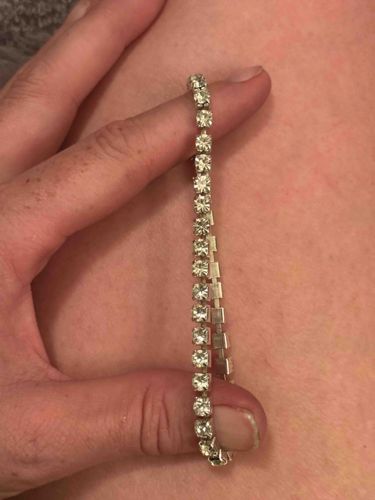
The item is a tennis bracelet, likely crafted from a silver-toned metal, possibly sterling silver, rhodium-plated base metal, or white gold, given its reflective, bright appearance. It features a continuous line of individually set, round-cut clear stones, which appear to be cubic zirconia, crystal, or glass rather than diamonds, based on their uniform brilliance and the probable context of such a design. Each stone is set in an individual four-prong setting, creating a flexible, articulated strand. The prongs appear secure, holding each stone firmly in place. The bracelet exhibits a classic, elegant design typical of tennis bracelets, which are known for their continuous line of diamonds or diamond simulants. The visible portion of the bracelet shows no significant signs of wear, such as missing stones, major scratches, or tarnishing on the metal, suggesting it is either well-preserved or relatively new. The clasp mechanism is partially visible at one end, appearing to be a box clasp with a safety catch, common for securing such delicate bracelets. There are no discernible maker's marks or signatures visible from the provided image. The quality of craftsmanship appears good for a costume piece, with uniformly set stones and a seemingly robust construction for each link. The style is timeless and can be worn for both formal and casual occasions. Without further inspection, including magnified views and testing, it is difficult to determine the exact material composition or the precise age, but it likely dates to the late 20th or early 21st century.
AI Appraisal Report
I have examined the provided image of this tennis bracelet. Based on my visual assessment, the bracelet appears to be in excellent condition with no visible signs of wear such as missing stones, tarnishing, or significant scratches. The stones, likely cubic zirconia, crystal, or glass, are uniformly brilliant, which often indicates they are not natural diamonds. Each stone is set securely in a four-prong setting, and the articulation of the bracelet appears sound. The clasp mechanism looks like a standard box clasp with a safety catch, common for this type of jewelry.
From an authenticity standpoint, I cannot definitively confirm the material composition of the metal or the exact nature of the stones without direct physical examination. While its appearance suggests a silver-toned metal, it could range from sterling silver to rhodium-plated base metal or even white gold. Similarly, the stones, while appearing to be simulants, cannot be conclusively identified without testing. There are no discernible maker's marks from the image.
In terms of market conditions, tennis bracelets with simulated diamonds are widely available, creating a competitive market. Comparables for such pieces range significantly based on material quality and brand. Demand for costume jewelry tennis bracelets is generally consistent, but their rarity is low due to mass production. Factors significantly impacting value here are the likely use of simulated stones and what appears to be a common metal (rather than precious metal). Had this been white gold with natural diamonds, the value would be substantially higher.
To provide a full and accurate appraisal, in-person examination would be crucial. This would involve specific gravity testing and magnification to confirm the stone type, metal purity testing (e.g., acid or XRF), and a thorough inspection for any unseen marks or damage. Provenance documentation, if available, would also aid in verifying the history and origin of the piece. Without these, my appraisal is based solely on visual aesthetics and typical market expectations for similar-looking costume jewelry.